Showing posts with label polls. Show all posts

Tuesday, July 9, 2024

The Rules of the Game


So French voters did that thing they do periodically, usually in a presidential election, and rejected fascism decisively in the second round of the snap legislative election. Somewhat grudgingly—they don't want the candidates they voted for to think they're impressed, but they know their duty.

As did the parties, which showed commendable discipline in carrying out the program of dropping out candidates to turn every race into the two-person race in which they had the best chance of defeating the Rassemblement Nationale. But it was the massive turnout that completed the job and defeated not just the fascists but the pollsters as well, who kept predicting a majority for the Rassemblement well into yesterday afternoon,  even as they noticed an unexpectedly large number of voters.

I couldn't help thinking I was seeing a repetition of a pattern we've been seeing a lot of lately, of voters breaking the poll predictions when they're voting to say there's a degree of authoritarianism they can't tolerate, in Brazil and in Poland, Spain and Iran, even when it's not enough to really change anything, as in the losses endured by authoritarian rulers of India and Turkey, and Hungary (in June's EU election), and of course in the United States of America in elections going back to 2018 reacting against the chaos of Trumpery, the terror of the incompetent COVID response and the racist violence of police forces, the overturning of Roe and rush to outlaw abortion.

I mean, it's not just heartening, but it's also interesting that the polls keep erring in that direction, with authoritarians underperforming. It doesn't happen when authoritarianism isn't a primary issue, like in Germany in June (where the appeal of the fascistoid Alternativ für Deutschland is still only in the former East Germany, while voters in the former West were punishing the sort-of leftist government by voting for the normie conservatives). Though in Britain one survey had Nigel Farage's "Reform Party" winning 18 seats in Thursday's general election (they won four).

Thursday, June 27, 2024

Another Day, Another Annoying Poll


Seeing some terror in the ranks over this poll of six battleground states issued by Washington Post (with the assistance of the Schar School of Government at George Mason University), particularly this result:


Even though these same respondents also seem to think Trump is a serious threat to democracy himself; a huge majority predicts that he will refuse to accept the results of the upcoming election, and a very substantial plurality believe Trump will "try to rule as a dictator" (while just a fifth, well within the crazification factor, suspect that Biden will do that).

I'm not going to be able to tell you what's going on here, because I'm stuck on a still more insane feature, which is what it's a poll of—it's a poll of particularly unlikely voters, designated as "The Deciders" for a fairly good but confusing reason, because they're in fact people who find it particularly difficult to make up their minds, don't know for sure whom they are going to support, and are just as likely to decide not to vote at all. Assuming, though, that the electorate is extremely tightly polarized to the point where the likely voters are almost equally divided, which is not an unreasonable interpretation of the normal polling data, it's the unlikely voters who will actually make the decision, for better or for worse or at random, by the way they sort themselves out in November. That's insane as a fact, that the decision is going to be made by the people with the least ability to even think about it, but it is a kind of a fact, and I ought to feel kind of flattered by the Washington Post for working on it, because, as I wrote for the first time in 2017,

Sunday, May 26, 2024

In the Unlikely Event

5/27: Updated version at the Substack


I hate the hypercorrect "whom" in that headline: a headline is a truncated sentence, and surely the truncated question it's answering is "Who is the presidential candidate voters say they'll support?", not "Whom do voters say they'll support as a presidential candidate?"

It's something from the Other Nate (Cohn, at The Times) that I'm taking a personal interest in, because I've been asking somebody with the resources to do it for a long time: going in search of the unlikely voter. Except he doesn't know that's what he's doing.

That is, when he was looking into the factors that might be associated with voter preference for Biden, he found that people who were otherwise likely to vote for Biden—self-identified Democrats, people who voted for Biden in 2020, minority members, the relatively young—it was those who didn't vote at all in the 2022 midterms, who were more likely to express a preference for Trump or no preference at all:

Thursday, March 28, 2024

Newsletter in the Strict Sense of the Term


Rep. Andy Kim (D-NJ) in the Capitol just after midnight, January 7, 2021, helping to clean up the garbage left by the marauding Yahoos. Photo by Andrew Harnik/AP via NBC News.

Unbelievable torrents of news over the last few days, as if coming down on us from one of those "atmospheric rivers" they have in California now (of which I have a mental picture like a Dr. Seuss drawing, with foamy, roiling blue waves at the border of the stratosphere and lots of careless but energetic fish doing aerial maneuvers).

***

In New Jersey, First Lady Tammy Murphy dropped out of the Democratic primary race to replace the abominable Senator Robert Menendez, now under indictment for (among other things) representing Egypt instead of New Jersey on the foreign affairs committee, though he still claims to be running as an independent. The presumptive nominee, Rep. Andy Kim of the suburban district 3 east of Philadelphia, filed immediately after Menendez's indictment, but Murphy seemed inevitable, with her husband's political might behind her and the special Jersey trick known as the County Line, where 19 of the state's 21 counties print their own primary ballots with a top line which the voter can pick to vote for all the candidates endorsed by their party machine at one blow, which generally always wins.

Monday, August 7, 2023

His Head Is Bloody and Unsound


A somewhat reassuring first snapshot of reaction to indictment no. 3, from CBS/YouGov.

That's not exactly a majority accepting Trump's criminal intent—it's well inside the MOE of 2.9 points—but more a reflection of the partisan division, with Independents split down the middle.

Friday, December 2, 2022

For the Record: Election Handicapping


Photo via.

Following up on the previous, some thoughts I had with regard to a longstanding with Thornton/Henry, who's right on this problem with election forecasting (not polling, forecasting, claiming to know with a certain probability who's going to win):

Wednesday, November 30, 2022

Likely Story

RKO, 1947.

I've got what may be one of those big ideas, that I've been nursing since Election Night and the Red Wave that never broke in spite of the handicappers, which is that there's something defective about the pollsters' traditional collection of data for adults, registered voters, and likely voters—they really need to be collecting data for unlikely voters, because they're the ones who make the difference.

This is just another way of putting a claim I've made before. What I normally say is that the normal pollsters' picture, where the electorate is made up of partisan voters who know what they want and swing voters who have trouble making up their minds whom to vote for, is wrong; the unpredictable part is really the people who have trouble making up their minds whether to vote at all.  

Those who get engaged enough to do it can be the ones, in principle, who decide the winner, if there are enough of them, as just happened on November 8, when the officially likely voters seemed to be red-waving as predicted, but the winning edge came from younger women fired up by the Dobbs decision, actually the most committed to voting, but counted as unlikely because they hadn't voted that regularly (or ever) before. Then again there was Florida, where the opposite happened, and unlikely Democratic voters disappeared altogether, in terrible turnout:

Friday, October 21, 2022

Coroner Brooks


Autopsy seen by Thomas Eakins, 1875. Imagine if the patient wasn't dead yet!

David Brooks ("Why Republicans Are Surging") has posted his autopsy of how Democrats lost the House and perhaps even the Senate, which gives me a little wan hope that that may not happen—it's not November 9 yet, and the proverbial fat lady just started her warmups in early voting in Georgia, where turnout began with an extraordinary bang, in numbers exceeding those of presidential-year 2020, suggesting a wild Democratic enthusiasm, or rage against those who have tried to suppress it if you prefer to think of it that way, at least in Georgia, which is a pretty important state this year.

And besides, most of Brooks's analysis is pretty weak-looking, dependent on that annoying Times-Siena poll Steve M and Joan Walsh have been dunking on, in which the likely voter screen focused on people who voted in one of the last four national or local elections (somebody with an effective 25% chance of showing up is a likely voter?) and underestimating the floods of mostly women who registered for the first time after the Supreme Court's decision overturning Roe v. Wade. 

Wednesday, January 5, 2022

Whoa, If True

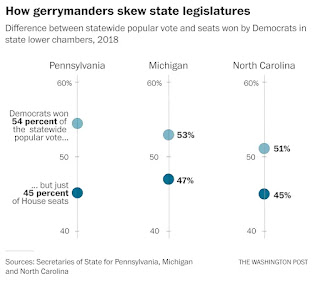
Speaking of Republican plots to ensure the party a permanent majority through gerrymandering of state legislatures and House districts, they've seemed pretty scary to most of us—they haven't pretended not to be doing it, and we've seen plenty of evidence of success in the disproportions, at all levels, between how many Republicans vote in a given contest and how many seat they win—sometimes grossly unfair, as in 2012, when Republicans won a comfortable 33-seat majority in the House with just 46% of the vote, or these crucial and grotesque results for local legislatures in the 2018 election


As Eric Levitz put it in New York's Intelligencer rubric on Christmas Day,

The Democratic House majority was supposed to die in redistricting. For months now, pundits and political forecasters have predicted that Republicans could win back the House next year without flipping a single voter. After all, the GOP controls far more state governments than the Democrats, and this is a post-Census year, when states redraw their congressional maps. Republicans boast sole authority over the boundaries of 193 congressional districts, while Democrats command just 94. Given the slimness of Nancy Pelosi’s majority, several analyses projected that GOP cartographers would generate enough new, safe “red” seats to retake the House through gerrymandering alone.

But now, Levitz continued, Democrats seemed to be doing "weirdly well" in the redistricting process:

Monday, July 26, 2021

For the Record: Political Journalists

Following up on this now deleted tweet:


Starting with this CBS News reporter, whose Twitter bio says she's an "unrepentant candy corn apologist" and "Cheez-Its stan",  showing I guess that she's not afraid to make the tough calls:


I had a lot of intellectual trouble with that survey result, anyhow.

Sunday, March 1, 2020

About that brokered convention...


Via fivethirtyeight.com.


That's overnight. Biden has pulled well ahead of Sanders in North Carolina in their simulations, just ahead in Virginia, virtually even in Texas for Super Tuesday, and well ahead in Missouri, Mississippi, and Florida a week or two later. A couple of days ago Biden seemed likely to lose in his own home state. Not today:


I can't imagine there's much of a chance for Elizabeth Warren (or Buttigieg or Klobuchar, let alone Bloomberg) to take the nomination in Milwaukee in July—don't even have an idea how you'd go about calculating it—but I hope she has lots and lots of delegates anyway, for the leverage it'll give her, and women, in the writing of the platform and selection of a nominee. That scenario that looked like a hopeless but entertaining daydream last Wednesday is now something people need to be planning for, and some are. Fivethirtyeight isn't saying it out loud in their coverage, so you may have read it here first (Martin, who I've been neglecting lately, has more to say).


Saturday, August 3, 2019

Horse race stuff

Théodore Géricicault, The Wild Horse Race at Rome, ca. 1817, via Wikiart.

I've been looking at extremely interesting ideas (warning: when I say "extremely interesting" I may really mean "in agreement with my naive expectations that nobody else agrees with or has corroborated", just the way most people do) about the US electorate being developed by a political scientist called Rachel Bitecofer at the Judy Ford Wason Center, Christopher Newport University, in Newport News, Virginia, making election predictions on the hypothesis that the behavior of "independents" isn't especially important, and the effects of what she calls "negative partisanship" are (it's not that simple: it considers a lot of factors, in two separate tiers, and regression analysis).

Which led her to predict last November's Democratic gain of 42 House seats (she said 43) in July 2018, when mainstream forecasters were unsure whether Democrats would win the 23 seats they needed to take the majority, which was a pretty remarkable feat, and is leading her now to predict a very solid Electoral College victory for the Democrats in 2020, without knowing who the candidates are. You'll have to check out the paper to get the details, because that's what I'm running this post to get you to do.

I was especially taken by Bitecofer's analysis of what happened in the 2016 election, because it not only puts to rest the zombie story of the "white working class" as decisive factor but also gives the first precise estimate I've seen (schematic, not numerical) of the influence of the Russian active measures:

Saturday, July 13, 2019

Is This Phase One of Lumpy Identity Politics?


In a really annoying exchange with some Rose Twitter folks:


Erased! That's a funny idea of what polls are supposed to do. "Waiter, send this poll back! It's ignoring me, merely because I belong to a minority!"

Friday, December 29, 2017

Annals of Derp: The Gallup Most Admired

William-Adolphe Bouguereau, Gypsy girl with Basque drum. Via Enigm-Art.

You know who's really the most admired woman in the United States? Somebody you've never heard of. I'm not even kidding: that was the answer 13% of the respondents in Gallup's 2017 survey, "friend/relative". The most frequent answer, given by 27%, was "don't know". Hillary Clinton only came in third, at 9%. Or maybe she was more like 13%, or 5%, because there's a four-point margin of error.

Puttting it another way, this is a really dumb survey, and always has been. It may tell you how many Americans say they admire Hillary the most of all women, around nine in a hundred, or around 94 of their 1,049 respondents (the given number is some manipulation of the raw numbers of those who named her as first and as second choice both). It doesn't tell you who America admires the most—that would take a different kind of poll, maybe taking the top 50 names on these lists and asking a second sample to rank them all.

It doesn't signify nothing. There is some kind of meaning to the suggestion that Barack Obama is more admired than Donald Trump (though only 17% to 14%, well within the margin of error), or that Hillary Clnton is still definitively on the women's list (9% to 7% for Michelle Obama). But it isn't much.

And down below the scale, where Condoleezza Rice and Melania Trump are tied for seventh place at 1% each, about the same as Bernie Sanders (7th place) and Bill Gates (8th place) on the men's list, it's really meaningless. It's comical and a little pathetic when the Free Beacon calls attention to the prime minister of Israel:

Israeli Prime Minister Benjamin Netanyahu is America's most admired foreign democratically elected male leader, according to an annual Gallup survey.
Netanyahu was ninth overall on the list of most admired men by Americans, with about 1 percent of respondents naming him. He is currently the second-longest serving prime minister in Israel's history after David Ben-Gurion.
The Dalai Lama was 11th on the list.
Fewer than one in a hundred think of naming Netanyahu, and fewer still of the Dalai Lama (who's actually tied for 10th place, with Mike Pence and Jeff Bezos). What differentiates him from Justin Trudeau at 13, Theresa May (14 on the women's list), Aung San Suu Kyi (much further down), Vladimir Putin, Tony Blair, and Nelson Mandela and Benazir Bhutto, the last two not even alive though the questionnaire specified that they had to be, is pretty much random error.

It's fun to talk about these numbers, but you should avoid thinking you learned anything from them,

Cross-posted at The Rectification of Names.

Wednesday, August 16, 2017

Turnout troofing

Yesterday the Times Upshot ran a piece by Nate Cohn analyzing the 2016 presidential election in terms of what looks to me like another take in the Legendary White Working Class family of takes, identifying the crucial factor in Trump's victory as that particular set of white-no-college voters who voted for Obama in 2008 and/or 2012 but for Trump in 2016, and who are said to have made this remarkable switch mostly out of racial resentment (I actually don't think that's as bizarre as it sounds, but the obvious question it raises, of why a white person who voted for Obama one year would turn around against Clinton out of racial resentment the next time, is one Cohn doesn't even discuss) and then out of disappointment with Obama and then lastly because they agree with Trump's policy prescriptions as they understand them.

Which Cohn does not take to mean that Democrats need to appeal more to racists, even though that's what his data makes it sound like, but that we should take positions more like those of imaginary Trump, in favor of lots of infrastructure spending, and trade protectionism, and relatively relaxed sexual views. The great Zandar of Kentucky, though, hears Cohn thinking it, and he doesn't like it:

What that means is that Cohn is strongly suggesting that in order to be competitive, Democrats have to make a sea change to attract voters that harbor no small amount of racial resentment. Trump was able to leverage that resentment into massive distrust of the Obama administration and Democrats in general.
The problem is that this will come at a cost, and the cost will be borne by black, Latinx, and Asian voters and candidates [and female candidates too, I'd add].  I've said before that this path is suicidal for the Dems and so far Trump is making it incredibly easy to make the Democrats be the party of inclusiveness in comparison by simple dint of Trump's overwhelmingly awful racism, if not open support of white supremacists.

Nor do I.

Monday, April 24, 2017

Sure you want us to look at that poll, Donald?

Watchmen's Ozymandias, via Comic Vine. 

Popularity-obsessed Trump bragging on the results of the latest survey from ABC-Washington Post:

If they blew it so badly five months ago what makes him trust them now? As you know, they didn't blow it; their finding, that Hillary Clinton would have won a national election if the US had national elections, by a handy 2 or 3 million votes, was correct. The forecasters who were wrong (and not big but very narrowly), were those who studied the 50 separate state elections and missed the results in three, Wisconsin, Michigan, and Pennsylvania, where a hundred thousand or so votes gave Trump an unexpected 46 electoral votes and the presidency.

In any case, is he sure he wants us to look at that poll? Because 53% called him a strong leader? Sorry, all sorts of politicians are strong leaders, including Mussolini and, um...

Saturday, November 5, 2016

Annals of Derp: Handicapping the 2016 race

Hi MBRU Cowpokes, and thanks as ever, Blogenfreude!

Clara Bow in William Wellman's Wings (1927), from somebody's Pinterest.


Watching all day in wonder as the Twitter reports extraordinary volumes of early voting in Florida, Nevada, and North Carolina (contrary to Elaine's tweet there), with the implications of higher than expected participation by women, Latinos, and African Americans and concomitant higher hopes for Democrats in those states, and FiveThirtyEight continues not to reflect this sort of thing, by design, as Silver explains:

Sunday, October 30, 2016

Sunday Tweets


I want to say I thought this was kind of encouraging; not that these numbers have any kind of predictive application I can see, but in that 13% of Clinton voters saying the FBI director's weird maneuvers actually make them more likely to vote for her, substantive signs of a sentiment I hope would take hold, of just rage at the way these dark and powerful forces are trying to manipulate us, and determination not to be manipulated.

(While the Republicans who say they're less likely to vote for her are wrong; they couldn't be any less likely than they already were.)

Had a sort of popular tweet referring to the wonderful David Farenthold report on the generosity of the Trump Foundation

and a not-so-popular one, or frankly a wholly ignored one that I liked a lot, using a format related to the Radio Yerevan joke, as in "In Soviet Russia, television watch you":

Wednesday, September 28, 2016

Scoop: Who's the second-most unpopular presidential candidate in US history?


Hint: It's not Hillary Rodham Clinton. Not, at least, today, according to this morning's Ipsos-Reuters daily tracking poll (data collected September 22-26, and thus not reflecting Monday night's debate). And it's not the first time it's happened—just before the Republican convention was one time, and just after the Democratic convention was another, but this time it has the long gradual slope of a real trend, since September 7 or so, and she's gotten down to two points underwater, 51% unfavorable to 49% favorable, and the effects of her debate victory and that shimmy will be showing up in the next few days. This could be a real scoop, because I haven't seen anybody else reporting it in these terms. (I sent out a couple of Tweets but they did not attract huge attention.) We'll see.

Who's the no. 1 most unpopular presidential candidate in US history? That hasn't changed all year. It's the guy with the short fingers, gold-plated toilet seats, and somewhat insensitive attitude toward women. He's got the Deplorables, and their conventional conservative hostages, but a very substantial majority of the population really doesn't like him. (Though at the end of September 1992, George H.W. Bush, who may be the second-most unpopular presidential candidate in US history, was actually more unpopular than Trump is now, 16 points underwater compared to Trump's 14, and he never really did climb out of there until near the end. Just sayin.)

The question is how many people who truly detest him will end up voting for him. I'm sure a good number of those with seven-figure incomes will, because the deal just looks too good to pass up: one or two hundred thousand dollars a year, if he's able to push it through.