Showing posts with label elections. Show all posts

Monday, May 25, 2026

Autopsy-Turvy


So I bet a lot of you thought the official party autopsy of the 2024 presidential election, released on Thursday, was probably concealing some awful ideological truth the DNC didn't want you to know, and that's why Ken Martin wanted to keep it secret, but it turns out it was merely incompetent, assigned to a writer who either didn't know how to do it or didn't have time, and produced a document that was woefully incomplete both in form (a lot of the chapters promised in the table of contents don't seem to have been written at all) and in content—as Michelle Goldberg wrote for The Times,

What’s most striking is its utter lack of substance. The words “Israel” and “Gaza” don’t appear once in its 192 pages. It offers little insight into why the Democratic Party lost large numbers of Black and Latino men, or its failure to speak to disconnected, irregular voters. Much of it is a string of platitudes, like this: “It’s imperative that Democrats meet the moment — by identifying and preparing the leaders and organizers who will deliver positive change for America.” I wondered if it was written by A.I....

and so poorly conceptualized that Martin felt the DNC couldn't take responsibility for the thing and festooned it with red marks like an angry professor reacting to a bad term paper.

Leaving the rest of us largely mired in the same old debate as to whether we ought to pull our wagon out of the rut and over toward the middle of the road or out to the left shoulder for the next phase of the journey, as if that humble metaphor provided an adequate characterization of all the human possibilities, only with even less hard information than usual.

Saturday, March 28, 2026

Gamechangers


Portrait of a bullet by Doug Mills, The New York Times, via Reddit.


Interesting report in Washington Post (this was a gift link from Bluesky that worked for me) on the presidential election campaign in Hungary, where the fascistoid incumbent Viktor Orbán appears to be in serious trouble:

Officers from the [Russian] intelligence service, or SVR, suggested that drastic action might be necessary — a strategy they called “the Gamechanger.” In an internal report for the SVR obtained and authenticated by a European intelligence service and reviewed by The Washington Post, the operatives proposed a way to “fundamentally alter the entire paradigm of the election campaign” — “the staging of an assassination attempt on Viktor Orban.”

You know what it made me think of. 

I've never had any patience with the conspiracy theory of the assassination attempt on Trump of July 13 2024, because of all the uncontrollable variables: in the first place there really was a shooter, killed on the spot, of course, so his motives can never be investigated; the four seconds he was given before the local security team put him out of commission, he got off eight shots that hit either three or four people, killing Corey Comperatore and critically injuring two other audience members and probably grazing Trump's right ear (the hardcore conspiracy theory holds that he or somebody with him was prepared with fake blood to smear on his ear after he dropped to the ground). I don't see how the conspirators could have been certain that the shooter, who was clearly prepared to die on the spot, could be counted on to miss Trump, or that he could have come as close as he apparently did, if he didn't intend to kill him. The astonishing photo by NYT's Doug Mills showing a bullet flying toward Trump's right ear could conceivably have been doctored, but that would have expanded the necessary number of conspirators beyond plausibility to include the forensic analysts who decided it was authentic and Mills himself. 

Tuesday, November 4, 2025

New York Note

 Happy Election Day! I don't feel like I need to give you a lot of advice about the candidates in New York City, but I thought it might be useful (if late, considering how many people have already voted by now) to say a couple of things about the six ballot propositions, for which the argumentation on both sides, seems to be just diabolically badly written.


Proposal #1: Amendment to Allow an Olympic Sports Complex on Forest Preserve 

This state question is really irritating, because voting for it will ratify an old crime, but voting against it will make it impossible to do anything about it. The crime was the development for the Mount Van Hoevenberg Winter Sports Complex for the Winter Olympics in 1932 and 1980 and other events, in particular the bobsled run, on land that was constitutionally required to be kept "forever wild". You can't actually "allow" it, regardless of what the language of the amendment may say; that train left the station a long time ago. 

What the amendment does, rather, is to say "It's not illegal any more!" Voters are offering them a pardon. Instead there is some restitution; a package of 2,500 acres of Adirondacks land that will remain forever wild in place of the original (which is frankly not that wild, I think—it's been settled, however sparsely, for centuries, and that's just the white people). 

But given that the land in question is already lost, it's probably the best that can be done. I'll vote yes.


Proposal #2: Fast Track Affordable Housing to Build More Across the City

Three proposed revisions to the city charter have to do with affordable housing; they were the creations of a Charter Revision Commission appointed by Mayor Eric Adams, they're ostensibly aimed at  breaking down some of the bureaucratic barriers, but some have also suspected some kind of plot on the mayor's part to grab some of the City Council's power. The pleasant thing about that is that Eric Adams is definitely not going to be the next New York mayor, so we can look at the proposals on their own merits.

Proposal #2 creates two  new processes for fast-tracking affordable housing projects; one keyed to publicly financed projects, and the other to the 12 community board districts with the lowest rates of affordable housing development over the past five years. Both remove City Council approval from the list of requirements, which may sound undemocratic, but the community board review might be thought more Democratic. After long hesitation, I'm inclining to Yes.

Proposal #3: Simplify Review of Modest Housing and Infrastructure Projects

This fast-tracks small-scale projects, also subject to community board review but not City Council. Again, Yes.


Proposal #4: Establish an Affordable Housing Appeals Board with Council, Borough and Citywide Representation

This is the most charged. Projects that are not fast-tracked will be approved, as always, by the City Council, with the member whose district is affected enjoying a kind of courtesy veto right. Whenever the City Council rejects an affordable housing project, though, the decision can be appealed to a board consisting of three people: the Council Speaker, the borough president, and the mayor. There is a question of NIMBYism operating here, and maybe a question of particular Council members. I love my own member, Gale Brewer, known as a staunch progressive and have loved her for years, for various reasons, but it's come to my attention that there has not been one single affordable unit built in my Upper West Side neighborhood, even as awful luxury condos spring up along Broadway without pause, and I don't think that's right. Voting Yes on this one too. (Non-billionaire Greenwich Village residents might like to think about this too.)

Proposal #5: Create a Digital City Map to Modernize City Operations

Are you kidding? Of course!

Proposal #6: Move Local Elections to Presidential Election Years

Why do we have to hold our mayoral election in the year before a presidential election? It's said that holding an election when nothing else is going on decreases turnout, but this is just an awfully funny year for worrying about that, because the turnout is already exceptionally high (factors are the horror at Donald Trump and his terrible presidency looming over the Republican Party and Zohran Mamdani and his extraordinarily attractive mayoral candidacy lighting up the Democrats in two different directions.

On the other hand, the small number of contests in an odd-numbered year, in Virginia, New Jersey, and New York City, attracts a tremendous amount of attention from the punditry to issues, ours, that don't always get a lot of attention, and what they represent for the current state of party politics.

Also, nobody's explaining how it's done: do all the City Council members just get their terms cut short by a year in 2028? 

So I'm actually voting No on this one.


Other than that:

Manhattan District Attorney (a state office):

Alvin Bragg, the only prosecutor who has ever gotten a criminal conviction against Donald J. Trump, 34 of them in fact.  He has also implemented bail reform with extremely good results, defeating the fear that letting more defendants off cash bail would lead to rises in crime rates, which has driven the Republicans to insanity (even as the city reaches historic lows in violent crime, they can't stop lying about it). There's a slightly mysterious candidate, Diana Florence, under the label A Safer Manhattan, and she has a gigantic advertising budget—one of her things has been to take over the marquee of the Beacon Theater (the venue for many high-end comedians and beloved rock revival tours, Bob Dylan was there not long ago)—I think there's something suspicious about her, but I'm hopeful it won't matter.

Other than that, there's not a lot I need to say, but for the sake of completeness:

Manhattan Borough President:

State Senator Brad Hoylman-Sigal

Mayor of New York City:

Zohran Mamdani!!!

City Comptroller:

Manhattan Borough President Mark Levine

Public Advocate:

incumbent Jumaane Williams

City Council Member:

incumbent Gale Brewer (running unopposed)


Tuesday, July 9, 2024

The Rules of the Game


So French voters did that thing they do periodically, usually in a presidential election, and rejected fascism decisively in the second round of the snap legislative election. Somewhat grudgingly—they don't want the candidates they voted for to think they're impressed, but they know their duty.

As did the parties, which showed commendable discipline in carrying out the program of dropping out candidates to turn every race into the two-person race in which they had the best chance of defeating the Rassemblement Nationale. But it was the massive turnout that completed the job and defeated not just the fascists but the pollsters as well, who kept predicting a majority for the Rassemblement well into yesterday afternoon,  even as they noticed an unexpectedly large number of voters.

I couldn't help thinking I was seeing a repetition of a pattern we've been seeing a lot of lately, of voters breaking the poll predictions when they're voting to say there's a degree of authoritarianism they can't tolerate, in Brazil and in Poland, Spain and Iran, even when it's not enough to really change anything, as in the losses endured by authoritarian rulers of India and Turkey, and Hungary (in June's EU election), and of course in the United States of America in elections going back to 2018 reacting against the chaos of Trumpery, the terror of the incompetent COVID response and the racist violence of police forces, the overturning of Roe and rush to outlaw abortion.

I mean, it's not just heartening, but it's also interesting that the polls keep erring in that direction, with authoritarians underperforming. It doesn't happen when authoritarianism isn't a primary issue, like in Germany in June (where the appeal of the fascistoid Alternativ für Deutschland is still only in the former East Germany, while voters in the former West were punishing the sort-of leftist government by voting for the normie conservatives). Though in Britain one survey had Nigel Farage's "Reform Party" winning 18 seats in Thursday's general election (they won four).

Wednesday, January 5, 2022

Whoa, If True

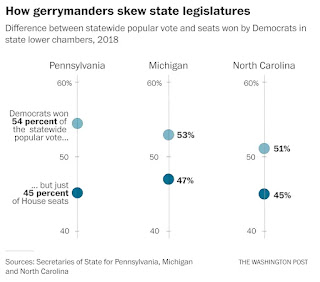
Speaking of Republican plots to ensure the party a permanent majority through gerrymandering of state legislatures and House districts, they've seemed pretty scary to most of us—they haven't pretended not to be doing it, and we've seen plenty of evidence of success in the disproportions, at all levels, between how many Republicans vote in a given contest and how many seat they win—sometimes grossly unfair, as in 2012, when Republicans won a comfortable 33-seat majority in the House with just 46% of the vote, or these crucial and grotesque results for local legislatures in the 2018 election


As Eric Levitz put it in New York's Intelligencer rubric on Christmas Day,

The Democratic House majority was supposed to die in redistricting. For months now, pundits and political forecasters have predicted that Republicans could win back the House next year without flipping a single voter. After all, the GOP controls far more state governments than the Democrats, and this is a post-Census year, when states redraw their congressional maps. Republicans boast sole authority over the boundaries of 193 congressional districts, while Democrats command just 94. Given the slimness of Nancy Pelosi’s majority, several analyses projected that GOP cartographers would generate enough new, safe “red” seats to retake the House through gerrymandering alone.

But now, Levitz continued, Democrats seemed to be doing "weirdly well" in the redistricting process:

Saturday, December 4, 2021

Movin' to Montana

Deeply exasperated by this op-ed in The Times from Steve Bullock, former Montana governor, former appallingly bad Democratic presidential candidate, and most recently crushed Senate candidate (he didn't lose as badly as Biden did in Montana, by ten points compared with Biden's 16, but still), lecturing us all about what Democrats are doing wrong ("I Was the Governor of Montana. My Fellow Democrats, You Need to Get Out of the City More."):

Thursday, November 4, 2021

Heuristics


Vie The Decision Lab,

You know who lost big in yesterday's election? Both sides—I mean, both sides of the "progressive"-"centrist" debate among Democratic party strategists. In Virginia, old-hat neoliberal Terry McAuliffe seems to have lost, just barely, to an empty-suit multimillionaire and the threat of Critical Race Theory. In New Jersey, Phil Murphy, one of the nation's most progressive governors, may or may not have just barely squeaked through against an empty-suit multimillionaire and the threat of "schools teaching sodomy in sixth grade." 

Murphy's bête noire, New Jersey Senate president Stephen Sweeney, ally of Camden kingpin George Norcross and leader of one of the most obstructionist "centrist" factions of Democrats, seems to be losing, also just barely, his own seat, which he's held for 20 years, in what they inevitably call a "stunning upset": 

Wednesday, June 16, 2021

New York Note


Maya Wiley, via Gothamist.

Early voting started over the week for the local primary elections in New York City, selecting candidates for mayor, city council, and so on in the November general election, but given the overwhelmingly Democratic character of the electorate, the party primary's winners are all more than likely to win then, so this is probably the more significant contest. I'm waiting for Election Day, personally—I've always liked the celebratory aspect (though I understand it's not convenient for everybody and won't be unless unless and until they make it a holiday) and feeling it this year in particular because it's another mark of the conquest of the pandemic that we're going to feel safe (masked, of course). 

And of another kind of renewal: New York, for all its progressive reputation, long had some of the most restrictive voting regulations in the country, thanks to Republican domination of the State Senate (in which, in recent years, Governor Andrew Cuomo collaborated), but the Democratic waves of 2018 and 2020 have given them not only control but a supermajority, which they have used for election reform among other things, including the early voting and no-excuse absentee ballots (not officially in effect yet but Covid-19, including not wanting to catch it, serves as a temporary universal excuse), and a good deal more to come.

Friday, December 13, 2019

Hi it's Stupid: Britain


Hi, it's Stupid to say the Conservative Party didn't win its election because the Labour Party was too far left, or because the Labour Party was anti-Semitic, but rather because everybody hates Jeremy Corbyn. He's just not likable.

As in Hillary Clinton was, as Obama put it, "likable enough", if just barely (the press could never tolerate her, perhaps because she couldn't hide her low expectations of them, but ordinary people mostly could, if they had a chance to judge for themselves), and he isn't.

This is why there are so many Brits who are willing to believe he's an anti-Semite: they're working under the assumption that anybody they know who's an anti-Semite is probably a pretty unpleasant person, not like that dotty prime minister Johnson, who looks like the Earl of Emsworth thinking of nothing but his prize fat pig, and who is self-evidently a jolly good fellow if not entirely reliable. They wouldn't lend Boris Johnson £50, and they're not crazy about having him for prime minister, but they can't imagine he'd be anything so reviled as an anti-Semite. Unpossible!
Boris Johnson has invoked some of the oldest and most pernicious antisemitic stereotypes in a book he wrote when he was a Conservative shadow minister. He describes “Jewish oligarchs” who run the media, and fiddle the figures to fix elections in their favour.

Monday, November 4, 2019

New York Note


I almost exercised my brand new right to vote before Election Day in New York, but the fact is my own polling place is less than two minutes away from home and news reports suggested early voting is doing great and it didn't need any encouragement from me to succeed and the fact is that while I enthusiastically endorse early voting as an option for those who have problems with Tuesdays, I also personally like participating in Election Day a lot, so I didn't.

Asked my family what they were planning to do and got one meaningful response, from the very smart Millennial who said she had sort of heard something about one of the five ballot propositions. Also, I hear that the propositions on the physical ballot or presented in 7-point type, and nobody's passing out magnifying glasses. So I decided that I should post a very short tutorial.

tl;dr: vote for all of them. Vote for Public Advocate Jumaane Williams to finish the term that Letitia James had to give up when she was elected state attorney general, and vote yes on everything else, viz., Propositions
  1. Ranked Choice Voting in all primary and special elections for Mayor, Public Advocate, Comptroller, Borough President, and City Council as of January 2021, which permits voters to register their second through fifth choices, which can in turn be used to create a kind of runoff vote when nobody earns a majority and encourages unexpected candidacies and interesting results and has worked really well where it's been tried in the US;
  2. increasing effectiveness of the Civilian Complaints Review Board for overseeing the city police, adding clout to the City Council and Public Advocate by giving them some nominations to the membership, and most importantly giving them more power to investigate cases, with subpoena power and the ability to investigate false cop statements;
  3. a miscellany of anti-corruption and good government initiatives including restrictions on lobbying for ex-officials; it's got a bunch of stuff good people can disagree on, and if you want to vote no on something this would be the place, but I won't;
  4. city budget reforms including a Rainy Day Fund, and
  5. land use reforms, giving more power to borough presidents and community boards to deliberate on land use proposals.
More information at The Gothamist, New York's best local paper, all online and now the property of WNYC radio.


Sunday, May 26, 2019

Anti-Fascist Roundup: Europe

I'm so glad Monsignor Ross Douthat, Apostolic Nuncio to 42nd Street, wrote his column about the death of Liberalism ("How Liberalism Loses")—
In Australia a week ago, the party of the left lost an election it was supposed to win, to a conservative government headed by an evangelical Christian who won working-class votes by opposing liberal climate policies. In India last week, the Hindu-nationalist prime minister, Narendra Modi, won an overwhelming electoral victory. And as of this writing, Europeans are electing a Parliament that promises to have more populist representation than before.
—just in time to anticipate the European results, in which the Liberals in the strict sense were by far the biggest gainers, alongside the Greens, or in general those on the more-or-less left with a strong commitment to European integration, as opposed to the more-or-less left that couldn't make up its mind about Europe in Britain and France in particular, and the pro-Europe Merkel conservatives, who endured the biggest losses.

Via The Guardian.
Anti-European reactionaries and nationalists did indeed increase their seat numbers, but in a clearly divided way between the proper hard right "Nationalists" in the chart) of Matteo Salvini's Lega in Italy and Marine Le Pen's Ralliement Nationale in France and the silly right "Freedom and Direct Democracy") of Nigel Farage's Brexit party, sadly the top vote-getter in the UK, and the Movimento Cinque Stelle in Italy which isn't really "right" at all; and plainly at the expense of the less Liberal.

Catastrophic, I'm sorry to say, for the SPD in Germany, which finished third behind the brilliantly performing Greens

Monday, February 25, 2019

New York Note


Tomorrow is a special election in New York City, for the position of public advocate, a weird NYC institution dating back to 1993, in which the designated successor in case anything happens to the mayor is a kind of official opponent of the mayor, a citywide ombudsman or tribune whose main job is to complain to the city on behalf of the citizens and attempt to shame the mayor and city council and city agencies into action.

It's also become a significant factor in electoral politics, in that the last two public advocates have successfully used the job as a springboard to higher things, Bill de Blasio to the mayoralty and Tish James to the post of state attorney general, in last November's election, which is why this election is being held, to fill it until the coming November, when there will be another vote.

It's a nonpartisan contest, though I think in fact there are only two Republicans on the list. and there are 17 candidates, which is just insane; there is a statistical possibility that somebody could win with just 6% of the vote, which is clearly very unlikely, but a win with some horribly low number under 25% and an essentially random result based on the vagaries of turnout is not inconceivable at all, and there are candidates trying unapologetically to work this.

In particular, because my family is on I don't know exactly what list of of Chinese or Asian voters, our mailbox has been full of bilingual Chinese-English fliers from one of the Asian American candidates, Ron Kim, directly appealing to us to vote for "one of us", which really kind of bothers me (that's the Korean; the Chinese guy, Ben Yee, is not doing that at all)—it suggests the possibility that the election could be won by voters of a single ethnic group.

In the same way, one of the Republicans, Eric Ulrich, could quite possibly win just by uniting the tiny minority of Republicans; or Danny O'Donnell, who was a pioneer as a victorious openly gay candidate for the state assembly in 2003 and has served there ever since, could be swept into office by a unified gay vote. Or Nomiki Konst bringing together all the Young Turks fans or just those who have a sense they've seen her name before and she's some kind of celebrity. Not that there's anything wrong with any of these people, other than Konst—O'Donnell in particular has been a fine assemblymember and there's no reason to think he wouldn't be a fine public advocate. Most candidates seem to take very similar policy positions and indeed struggle to distinguish themselves from each other. But I hope whoever emerges from this circus will give a sense of having been backed by a cross-section.

To that end, I've had my eye on two candidates in particular, former city council president Melissa Mark-Viverito and Jumaane Williams, the city council member who was crazy enough to run as Cynthia Nixon's running mate in last year's gubernatorial primary but sober enough to be endorsed by the New York Times for tomorrow. And his mom likes him, as he has pointed out. Williams has been the favorite, and I'll be voting for him because of that, in the hopes of encouraging it to look like a mandate.

Saturday, December 29, 2018

Kettle-Corn Kevin

Andy Warhol's Chelsea Girls, 1966.
London Skinheads, 1980s, photograph curated (I guess) by Sean Reveron.

Haven't noticed National Review's Kevin D. Williamson ("Whose Streets, Indeed?") doing this in a long time, pretending to be Tom Wolfe:

S
o there’s this really whacked-out young lady just absolutely spitting high on rage with one of those weird Chelsea Girl fringe haircuts like skinhead molls used to wear back in the Age of Reagan and she is right at this moment very fixated on — and I am not making this up — kettle corn, that weird repulsive caramel-coated Dutch mutant popcorn varietal sold at state fairs and any place men in laced-up pirate blouses are gathered, and she’s just going on and on about it, screaming at the top of her skinny little lungs: “It’s salty and sweet! It’s salty and sweet! It’s salty and sweet!”

This is some of your High Bad Writing indeed, pounding the reader with cultural signifiers without regard to the laws of physics, in allowing a character to be simultaneously wearing two completely different haircuts and whacked out on rage while fixated on snacks, I mean even if rage really does give you munchies, which is somewhat at odds with my own experience of both, can you be fixated on kettle corn and spitting with rage at the same instant? Or is it the kettle corn that enrages her? Is she high on rage because it's salty and sweet? Does that give her something in common with Kevin D. Williamson? How many places are there where men in laced pirate blouses gather, other than Disney movie sets and maybe a Halloween party gone wrong, and are any of them really state fairs? Do our lungs in fact comport with our body types, do we have fat lungs, skinny lungs, and mesomorphic lungs to match the various torsos that enclose them?

Friday, November 9, 2018

David Brooks Columns I Never Finished Reading

Sod House on the Prairie, Sanborn, Minnesota.


Jesus, Brooks ("What the Working Class Is Still Trying to Tell Us"):
I was ready for massive Democratic turnout for the election on Tuesday. But I was surprised how massive the Republican turnout was in response.
The Republicans who flooded to the polls weren’t college-educated suburbanites. Those people voted for Democrats this year....
These were high-school-educated, working-class Republicans.
In fact, as compared to two years ago, the Brookings Institution finds,

Thursday, November 8, 2018

Homeopathic Populism

Raspberry peach pie via Taste of Home.

I'm so tired of this hoary and false take on the 2016 election, as from Monsignor Ross Douthat ("Midterms Deliver an American Stalemate"):
Instead, after its nominee traded a lot of suburban voters for stronger working-class support in 2016, the Trump-era Republican Party has continued to hemorrhage suburbanites while also giving back some of those Midwestern, blue-collar gains. The political strategy for Republicans after Trump’s victory should have been obvious: Seal the working-class realignment with a dose of economic populism, hold the suburbs by dialing back the Trumpian excesses. Instead the president let congressional Republicans have their way on policy, and they let him be himself in other ways — which makes the Democratic sweep in the House exactly the outcome that both the soon-departing Paul Ryan and the president deserve.
Suburbia voted Trump by a 5% margin two years ago, compared to 2% for Romney in 2012:
Suburban voters particularly put Trump ahead in the crucial Midwestern states of Michigan, Wisconsin, and came close to winning him supposedly deep blue Minnesota. This is where the Democratic falloff from the Obama years was most evident, notes Mike Barone, falling from  dropping from 54 percent for Obama to 2008 to 45 percent [in 2016].
In fact people who work with their hands are allowed to live in the suburbs nowadays, perhaps contrary what the Monsignor has heard. It has actually been going on since the 1940s.

I love that concept of a "dose" of economic populism. It's a theory of homeopathic political medicine. You hold off revolution by administering tiny, almost undetectable gestures, like the Marco-Ivanka childcare proposals.

As to the reining in of "Trumpian excesses", does he think they haven't tried?
What about Democrats? If Republicans just spent two years squandering a chance at a populist realignment, their rivals spent Election Day proving that they have solved some of their Obama-era problems — midterm turnout, above all — without finding way to turn a popular-vote advantage into the Senate majority that, no matter how unjust liberals increasingly find the existence of the Senate, they still need to somehow win.
It's been obvious since long before the campaign started that the particular third of the states electing Senators this year were the wrong batch for Democrats. It's like when you go to the greenmarket during peach season and Ross says "Birkenstock-wearers still haven't found a way to turn flour, fat, fruit, and sugar into pumpkin pie." Just go away, please.

Bonus: I don't need to bother with Mr. Bret Stephens:

Wednesday, November 7, 2018

Moment of Zen


Bloedel Reserve, Bainbridge Island, WA, via 2TravelDads.

Woke up sometime between 4:00 and 5:00, neither on purpose nor insomniac, just quietly listening to the brainchatter, when I suddenly realized I had forgotten all about the election—it had been absent from my mind for, I don't really know, the whole ten or fifteen minutes I'd been awake. That was kind of nice.


Sunday, November 4, 2018

Lucky Ducky Democrats

Q: Why is the Trump-Putin relationship like the Rapanui heads? A: Nobody's been able to figure out how it was done! Image news.com.au.

Monsignor Ross Douthat, Apostolic Nuncio to 42nd Street, has a take with an insight-producing wrinkle ("The Luck of the Democrats"):
One of the interesting features of this election cycle has been the gulf, often vast, between the hysteria of liberals who write about politics for a living and the relative calm of Democrats who practice it.
In the leftward reaches of my Twitter feed the hour is late, the end of democracy nigh, the Senate and the Supreme Court illegitimate, and every Trump provocation a potential Reichstag fire. But on the campaign trail, with some exceptions and variations, Democrats are being upbeat and talking about health care and taxes and various ambitious policy ideas, as though this is still America and not Weimar, a normal time and not a terrifying one.
Weimar was an abnormal time, but not necessarily terrifying. It was a thrilling time, after the end of the sclerotic Second Reich, full of possibilities. Nobody knew enough to be terrified about the political situation, when it was the economics that seemed to be the problem. Angry, no doubt, but terrified? What's frightening so many of us at the moment is that unlike the Germans of 90 years ago we do know what happened to them. To me it still looks very much like a second-time-as-farce case, in that our American would-be fascists are really too inept to do the worst, and the legal dispensations too strong to allow them—as we've seen with the failure to dissolve Obamacare or halt the Paris Accord and now with the crazed but fortunately impotent response to the migrant caravan. They can do a lot of harm, I mean, but it's on a much smaller scale than Nazis.

Friday, November 2, 2018

Hi, it's Stupid: Election Edition

Haruspex examining the entrails of a sacrificed bull, after a drawing by the painter (Pierre?) Vauthier. Via.

Hi, it's Stupid to say the Democrats could win the Senate contest. Ask anybody!

But somebody's got to do it. I'm not saying they will win, or are likely to (I'm no good at handicapping anyway, but if I were to place a bet it would be for a 50-50 split), but in fact we know it's not impossible, Nate Silver is saying a 15% chance, and what I want to say here is that in the unlikely event that it does happen, I'm going to know why.

What Silver is saying now in prose, as opposed to the charts, is that if it does happen it will mean there's a "systematic error in the polling" he's working with:
By a systematic polling error, I mean one that occurs in a correlated way across every race, or in certain groups of races — not merely errors that happen on a one-off basis. Our models account for the possibility of several different types of systematic errors, but in this article, I’m going to focus on the simplest type of systematic error, which is a uniform swing that applies to every race.

Tuesday, October 23, 2018

It Was Good For the Hebrew Children

Hebrew Children in the Fiery Furnace, from Robin's Great Coloring Pages.

I've been neglecting David Brooks since he came back from his recent book-generating aestivation (an aestivation or estivation is like a hibernation only in summer), for reasons akin to those cited by blogfriend Andrew Johnston; he's really not giving me enough material that I haven't already dealt with (Drew shows convincingly that you could write a really thorough review of the new book before it's even published, so that it's impossible to see why you'd want to even look at it, let alone slaving over an analysis of the text).

There's a moderately funny bit in today's column, though, a pre-election whine about Democrats failing to make a serious attempt to get his vote by offering a spiritual program ("The Materialist Party"), instead of talking about health care, health care, health care, or
“The top three issues this year are health care, health care and health care,” J.B. Poersch, of the Democratic-aligned Senate Majority PAC, told CNN....

Thursday, September 13, 2018

For the Record: Sanctions Rise Again


So the White House has announced a new order sanctioning any country that interferes in US elections, or more precisely "enabling" sanctions, as if they weren't already enabled by legislation Congress passed over a year ago. BooMan explains that it's a fraud, the purpose of which is actually to stop Congress from putting more pressure on the administration, but I wanted to tack on a few words on the background: