Saturday, May 7, 2022

Opinions We Never Finished Reading. IV

Meanwhile, beyond the grim world of the witch killers Coke and Hale, there's evidence of more relaxed attitudes on both sides of the Atlantic, in some places that you might not expect at all. 

For instance, in 1729, around the same time as the prosecution of Eleanor Beare, a brand new newspaper, the Philadelphia Gazette, published by Samuel Keimer, was running a series of articles, presumably pirated, from a new English reference work, Chambers' Cyclopaedia, in alphabetical order, and apparently not paying enough attention to what he was issuing. It included a lengthy discussion of Abortion in the fifth number, which had been okay in a bound volume in England, but too explicit for the comfort of an American newspaper audience, reading a little like a how-to manual:

Anyway, none other than that first fearless American comedian-blogger, Benjamin Franklin, had a number of grudges against Keimer, who had given him his first job when he came to Philadelphia as a 17-year-old in 1723, and undercut his own plan to start a newspaper by founding the Gazette at the end of 1728. Franklin and some friends really intended to drive Keimer out of business, in a series of  satirical opinion columns published under the nym "The Busy-Body", in Andrew Bradford's American Weekly Mercury. He began, however, by mocking Keimer over the abortion article, in the following bogus letters to the editor of the Mercury:

Friday, May 6, 2022

Opinions We Never Finished Reading. III


Frontispiece from Matthew Hopkins' The Discovery of Witches (1647), showing witches identifying their familiar spirits for the Witch Finder. Via Wikipedia.

Hi, it's Stupid to criticize Justice Alito for citing a 17th-century jurist just because the jurist, Lord Edward Coke, happened to be an advocate of marital rape and had ordered women to be executed for witchcraft. After all, marital rape and the execution of witches are deeply rooted in our nation's history and traditions too! Besides, why should we suppose his views on these matters are even relevant in any way to his views on abortion?

Alito notes that

The “eminent common-law authorities (Blackstone, Coke, Hale, and the like),” Kahler v. Kansas, 589 U.S. __, —_ (2020) (slip op., at 7), all describe abortion after quickening as criminal. Henry de Bracton's 13th-century treatise explained that if a person has “struck a pregnant woman, or has given her poison, whereby he has caused an abortion, if the foetus be already formed and animated, and particularly if it be animated, he commits homicide.” H. Bracton, De Legibus et Consuetudinibus Angliae...

Although what Coke says, in fact, contra Bracton, is that it is not homicide, unless the child dies after being born, because while within the womb the fetus isn't really a person, a "reasonable creature", a thing in rerum natura, in the world of natural beings, and under the King's peace, that is a member of society:

Wednesday, May 4, 2022

Opinions We Never Finished Reading. II


Image from medievalists.net.

Question to Radio Yerevan: Is it true that the right to abortion was "was entirely unknown in American law"? And that "Indeed, when the Fourteenth Amendment was adopted, three quarters of the States made abortion a crime at all stages of pregnancy"?

Yes, but 

  • first of all, so was the right to stop women from voting (women could vote in several of the 13 colonies, but it was explicitly forbidden in all state constitutions by 1807)—men just did it without asking whether they had a right to do it or not;
  • second of all, it wasn't clear that women had any rights at all, since, as Justice Alito might say, the word "woman" doesn't appear anywhere in the Constitution; the "inescapable conclusion", as Alito might say, is that the existence of women is "not deeply rooted in the Nation's history and traditions", and not a matter on which the federal judiciary should speculate; and
  • third of all, while it's quite true that abortion "at all stages" (i.e., both stages, before and after "quickening") was criminalized in 26 states at the time the 14th Amendment was adopted in 1868, abortion providers plainly had a right to perform abortions before those laws were passed—it had to exist in order for the legislatures to take it away—and Alito's text doesn't say when they were passed: how "deeply rooted in the Nation's history and traditions" was the states' right (unenumerated in the Constitution but presumably guaranteed by the 10th Amendment) to stop women from terminating their pregnancies?

Helpfully, Alito does offer an appendix with dates and texts for all the original anti-abortion laws in all the states and territories, down to Mississippi in 1952 (really late to the party, as you might expect), and that gives us some kind of clarity on these matters.

Tuesday, May 3, 2022

Opinions We Never Finished Reading. I

GettyImages via The Independent.

Well, it took Politico and their sources about eight hours after I posted my prediction that the Supreme Court would not overrule Roe to publish the extremely strong indications that I was totally wrong, and you might forgive me for wondering if they did it just to humiliate me. 

Other than that, I am not at this time taking an interest in who the leaker of Alito's draft opinion, or whistleblower as the case may be. Effectively, the hullabaloo over the leaking might as well be meant to silence the discussion of the awfulness of the work, and I mean awfulness in every sense, from literary to legal, and that's what I'd rather be talking about, starting with Alito's opinion that

The right to abortion does not fall within this category [of unenumerated rights guaranteed by the Due Process Clause of the 14th Amendment]. Until the latter part of the 20th century, such a right was entirely unknown in American law. Indeed, when the Fourteenth Amendment was adopted, three quarters of the States made abortion a crime at all stages of pregnancy. The abortion right is also critically different from any other right that this Court has held to fall within the Fourteenth Amendment's protection of “liberty.” Roe's defenders characterize the abortion right as similar to the rights recognized in past decisions involving matters such as intimate sexual relations, contraception, and marriage, but abortion is fundamentally different, as both Roe and Casey acknowledged, because it destroys what those decisions called “fetal life” and what the law now before us describes as an “unborn human being.”

The "law now before us" being Mississippi's "Gestational Age Act", defining abortion as

the use or prescription of an instrument, medicine, drug, or other substance or device with the intent to terminate a clinically diagnosable pregnancy for reasons other than to increase the probability of a live birth, to preserve the life or health of the unborn human being, to terminate an ectopic pregnancy, or to remove a dead unborn human being.

and prohibiting all abortions after the "unborn human being" reaches the gestational age of 15 weeks, without the usual exceptions, where Roe allowed states to prohibit them after 24 weeks, and Casey after the age of "fetal viability". Although the whole thing is looking pretty moot because within ten days after the Mississippi attorney general determines that the Roe decision has been overruled by the Supreme Court, basically all abortions regardless of "gestational age" will be prohibited in Mississippi, under one of those "trigger" laws, passed in 2019

  • (1) As used in this section, the term “abortion” means the use or prescription of any instrument, medicine, drug or any other substance or device to terminate the pregnancy of a woman known to be pregnant with an intention other than to increase the probability of a live birth, to preserve the life or health of the child after live birth or to remove a dead fetus.

  • (2) No abortion shall be performed or induced in the State of Mississippi, except in the case where necessary for the preservation of the mother’s life or where the pregnancy was caused by rape... only if a formal charge of rape has been filed with an appropriate law enforcement official.

with a mandatory sentence of 1 to 10 years for the provider. I guess they promoted the termination of an ectopic pregnancy from "not an abortion" to "preservation oof the mother's life" but for some reason they dumped the "unborn human being" category, perhaps because ALEC has stopped using the phrase? (Earliest cite I find in a quick search is from 1994, by Robert P. George of the American Enterprise Institute.)

But the Supreme Court, tasked with deciding on the constitutionality of the 15-week ban in the Gestational Age Act, has in fact stuck Mississippians with this one, like a cuckoo's egg, without arguing it at all.

And meanwhile, Alito has skipped over the contrast between "fetal life" and "unborn human being" and decreed without any argument at all that the latter is all you need to know, meaning he's decided in advance that abortion rights are fundamentally different because they are a right to murder (except in the case of an ectopic pregnancy, in which I suppose the reason the abortion isn't abortion is that it's in self-defense—that fetus is trying to kill her!), and there's no real reason to discuss it any further. But he does, all the same. for 90-odd pages. 

In the next installment, we'll be looking at "entirely unknown in American law" from a historical point of view.

Monday, May 2, 2022

Deep in the Dark of Texas


Wendy Davis, ready to run, via KTSA TV.

Maybe the most personally infuriating thing to me about the current flurry of state anti-abortion legislation is its open contempt for the rule of law: I mean these mean-minded, pinched and intolerant people, so ready to judge others for the slightest deviations from their own idea of propriety, passing laws that are flagrantly illegal according to settled law (as the members of a Supreme Court majority from Roberts through Kavanaugh and Barrett have maintained in their confirmation hearings). 

The "trigger laws" in something like 20 states from the previous wave were designed to take effect only after such a time as Roe and Casey are overturned, should that happen (I'm not convinced it will, at least this year, though they'll undoubtedly continue working to cripple abortion rights around the edges). The current wave, in Mississippi and Florida and Oklahoma and wherever else, is as if the law doesn't even exist; it's pretty much as if they passed a law legalizing slavery, or denying women the right to vote. Saying, as they do, that it might be constitutional soon, after the Court rules on the Mississippi law, doesn't cut the mustard: it's unconstitutional now, and they know it.

And the Texas law, the infamous SB8, is the worst of all, with its sly legalism in the provisions designed to prevent the Court from considering it—since the state is not enforcing the law, simply inviting bounty hunters to enforce it privately by suing anybody who assists in providing patients with abortion services in the state, for $10,000 in punitive damages, nobody has standing to sue the state, as decided just last week. 

Sunday, May 1, 2022

Back to Class

 Happy International Labor Day!

Krugman sticks this thing ("Education has less to do with inequality than you think") under his "Wonking Out" rubric, which is a shame, because that means a lot of people who need to read it won't, and since it's indirectly making a point I've been making for a long time, but making it with an expertise I couldn't come close to, I wanted to highlight it.

His immediate purpose is to defend the idea of a broad-based program to cut or eliminate student debt, like the one Biden promised in the 2020 campaign and has recently returned to talking about; a widespread criticism of such a program is that it rewards people for doing something for which they have already been rewarded, with a college degree:

Wednesday, April 27, 2022

I'm a Congressman

With acknowledgments to Monty Python's Flying Circus 


I'm a congressman and I'm okay
I like to work and I like to play

He's a congressman and he's okay
He likes to work and he likes to play


I punch up trees, I drive fast cars,
I work in Washington.
And when I take an airplane
I always pack my gun.

He punches trees, he drives fast cars,
He works in Washington.
And when he takes an airplane
He always packs his gun.

Friday, April 22, 2022

Narratology: Jared the Spy

Photo by Jonathan Ernst/Reuters via The Times (UK).

I realize there's an awful lot to think about at the moment, but this week-old piece by the estimable Vicky Ward (author of the 2019 Kushner, Inc.: Greed. Ambition. Corruption. The Extraordinary Story of Jared Kushner and Ivanka Trump), really shouldn't be allowed to wash away in the flood.

It offers a very plausible account, based on Ward's own sources, of exactly what the Saudi Arabian sovereign wealth fund was paying for with their $2 billion investment in Jared Kushner's new investment firm, in the context of a power struggle that had been going on in the kingdom since early 2015, when King Salman, who had been king for just three months, appointed his nephew Mohammed bin Nayef (MbN) as crown prince, and his own son, Mohammed bin Salman (MbS) as deputy crown prince; namely, alleging that Kushner conspired with MbS to get him named crown prince and MbN thrown in prison in 2017, including by passing him classified material to which he had access thanks to the security clearance Trump insisted on giving him.

Which would make him guilty of more than just a Foreign Agents Registration Act violation, if true (Kushner has denied passing classified material to anybody)—like espionage, or the "espionage lite" of Section 951, in which

Tuesday, April 19, 2022

Blogging Beyond Theocracy: Technical addendum

 Last paragraphs revised 20 April (around 4:00 AM)

Birth of Dionysos (at center, getting pulled out of Zeus's thigh, with his crown already on). Apulian red figure kraton, late fifth or early fourth century B.C.E., via theoi.com.

The following statements are all probably untrue:

(1) When Zeus's pregnant girlfriend Semele saw him in his full divine splendor, the sight literally burned her to death, so he snatched the fetus and sewed it up inside his thigh in order to bring it to term.

(2) When Mrs. Bennett heard that somebody was moving into the big house at Netherfield she immediately decided the new guy ought to marry one of her five daughters. 

(3) When the Moskva blew up and sank in the Black Sea, nobody knew what caused it to happen.

But they are untrue in obviously different ways, with obviously different functions, even if it may be difficult to say what the functions are. 

The last, the lie, is the easiest: it's meant to deny the truth, which is that we know very well what caused the ship to sink, two Neptune missiles fired by Ukrainian forces. 

Sunday, April 17, 2022

Blogging Beyond Theocracy

Gut yom tov, merry Easter, and Ramadan kareem to all who celebrate, and at least some merriment to those who don't (I got to attend the extended family seder last night, for the first time in three years, and that's something to be grateful for), because we could all use some merriment right now, regardless of faith or lack thereof.


St. Conilius of Bologna, British Library Medieval, Add. 49622., via.  Just kidding. But the manuscript shelfmark is real.
The tradition of the Easter egg commemorates a miracle in the vita of the martyred Saint Conilius, deacon in a congregation of 5th-century Bononia, who found his family at the end of one Lent too poor for meat with which to break the fast, except a little bacon. He saw a fat hare in his garden, nibbling at the new ramps, and lunged for it—but as he was readying himself to break its neck he saw its eyes filling with tears, and bethought himself of the Blessed Virgin's suffering through the death of her Son on the Cross, and let the animal go. It scampered away, but not without pausing here and there in the bushes, where it miraculously laid a sequence of eggs about the size of duck's eggs and equally rich, in a rainbow of different colors. Conilius gathered up a dozen or so and brought them home, where he invented spaghetti alla carbonara.
Wrote this back in 2013, and reprinted the original post that contained it in 2015, and always felt it has not been sufficiently praised, possibly because it came at the end of the o.p. and nobody ever read that far, so this is a re-up of the 2017 version.

Of course it is an alternative fact, not true, or #fakenews, depending on your political opinions. It did not happen, nor has anybody other than me ever said it did. It is an inauthentic myth, as is the story circulating on Twitter:

Friday, April 15, 2022

A LOST WARSHIP


So, we learn that the Russian Navy’s Black Sea flagship RTS Moskva (121) has sunk while being towed toward Sevastopol, Crimea, after sustaining major damage in a fire Wednesday.  I have little doubt that the Kremlin chose not to say that the "fire" was caused by two of Ukraine's "Neptune" anti-ship cruise missiles striking the ship and causing fires that reached the vessel's ammunition magazines, igniting secondary explosions that made the ship a flaming, leaking hulk that finally succumbed to bad weather.  

My guess is that she was a constructive total loss long before she slipped beneath the waves.  It could hardly be otherwise if the entire crew was ordered to abandon the ship because "damage control" was both impossible and pointless.

I am, of course, not "rooting for the Russians" in this war. Russia's aggression, wanton destruction, and countless war crimes immediately perish the thought.  The only way this war will end properly is if Russia suffers such enormous losses that not even a monster like Putin will consider embarking on another such "noble cause" in the future.  

Even so, I felt a strange twinge of sadness hearing that the ship had gone down.  There is a finality to a major warship sinking that approximates a human death.  It's gone.  You can't bring it back.  In contrast, even a horribly damaged warship can be brought back if the hull is sound.  Consider the USS Belknap (DLG-26) after a collision with the Navy carrier John F. Kennedy on November 22, 1975. 

The Principle of Explosion


Classic XKCD.

A weird little detail on BBC this morning from their Moscow correspondent doing what Moscow correspondents need to do a lot of nowadays, watching TV: In re the sinking of the Moskva, state television is denying, as you'd expect, that Ukraine had anything to do with it (yes, there was an explosion of ammunition on board that damaged the ship's hull but more or less no attempt to explain what could have caused the explosion, and the ship sank after "losing its balance" as they were towing it back into port), but in the middle of this discussion some talking-head military expert says that this is an act of war for which Ukraine will have to be severely punished—not if this is Ukraine's responsibility, but making the unspoken presupposition that it is, sitting inside a conversation in which everybody agrees it isn't.

Reinforced by the subsequent news of the Russian bombing of the Vizar plant near Kyiv where the Neptune missiles, which as we understand actually sunk the Moskva, are made, which we're clearly meant to read as a very precisely targeted response to the sinking, but the Defense Ministry issues a very precisely targeted assertion that it is something else:

Thursday, April 14, 2022

C'est la faute à Rousseau

Just ten years ago, when the blog was just getting going, Rectification Central was all excited over a French presidential election, in which the Socialist Party's François Hollande defeated the corrupt conservative Nicolas Sarkozy. I appear not to have written a post claiming that all Europe was coming to its senses in acclaiming a triumphant left, but I'm pretty sure that's what I thought.

Sadly, no. Five years after that, the Socialist Party had virtually vanished from contention, and so had Sarkozy's Union pour un Mouvement Populaire, the last gasp of the former UDF, or whatever that thing was that was equally opposed to socialism and Gaullism, an exhausted iteration of the French version of Christian democracy that wasn't particularly Christian or democratic, or anything really.  Rather, the contest seemed to have altogether personalized itself at last, among a collection of new characters rather than parties with ideologies: Marine Le Pen, daughter of the fascist Jean-Marie Le Pen, representing a neofascism "with a human face", so to speak; Jean-Luc Mélenchon, representing a kind of nationalist left more worried about "globalism" than anything else (though he has been pretty positive about immigrants, which I consider good, of course, and a bit brave as well); and Emmanuel Macron, representing some kind of ideal of bureaucratic competence, which won, not because anybody liked it very much but because they were less frightened of it than the others, a pattern that seems to be replicating itself this year.

When I find myself wondering if this is going to be the new party system in France after all, an essentially two-party system that weirdly resembles some of the stupidest takes on our own situation here in the US, polarized between an authoritarian conservatism that identifies itself as "populist" or "working class" (meaning of course "white working class") and a kind of authoritarian liberalism that identifies itself as smarter than you, technocratic, unapologetically elitist. While the left properly speaking is permanently sidelined, in its inability to recognize that it needs to adapt to flourish in a "center-right" country.

Wednesday, April 13, 2022

For the Record: Double Standard

"The Affair", 1875, via The Lighthouse.

>

And of course "good" people are variously proprietors as opposed to renters, or investors as opposed to laborers, or married folks as opposed to disorderly cohabitors, or "Judeo-Christians" as opposed to scandalous unbelievers, or supporters vs. opponents of patriarchal social organization, or more often than not white people as opposed to dark, depending on what part of the coalition you're trying to rile up. That's pretty much the whole story.

Tuesday, April 12, 2022

Subway

36th Street station on the D line was also the site of a slashing incident in August. Uncredited photo via WPIX TV.

I don't really have anything vital to say about the shooting incident in Brooklyn this morning except to think about how much time I spent in that station, 36th Street at 8th Avenue, when we lived 20 blocks west of there in Brooklyn's Chinatown in the later 90s and it was the best stop for changing between the R local and the D express on the way to and from Manhattan, through the toddlerhoods of two kids, often in an unfolded stroller hung around the handles with plastic bags from shopping, which I had to wangle up and down the stairs (occasionally with the unexpected assistance of some friendly volunteer out of nowhere). It's just such a profoundly ordinary place.

End gun violence, please.


Monday, April 11, 2022

If it's what you say I love it, especially on January 6


Former White House Chief of Staff Mark Meadows, who "frequently cries at work." Screenshot from video at Huffpost.

aardvarkcheeselog comments:

Is there any doubt at all that Mark Meadows defied a Congressional subpoena? What is the hold-up on indicting him for that, since Congress declined to do so on their own hook?

It would be easier to expect good faith from DOJ if they were doing anything to discipline scofflaws that don't need cases built against them. Maybe I am not paying enough attention to news and am missing reports about this?

It might be interesting to ask why Congress declined to do it on their own and kicked the can over to DOJ instead. It's my impression that they have almost never done that historically, but they've done it four times in the January 6 investigation: for Bannon in October, for Meadows in January, and for Scavino and Navarro last week.

The procedure for criminal contempt (as opposed to inherent contempt, handled by Congress, or civil contempt, for the Senate, when they sue the party in civil court), is:

Following a contempt citation, the presiding officer of the chamber is instructed to refer the matter to the U.S. Attorney for the District of Columbia;[20] according to the law it is the duty of the U.S. Attorney to refer the matter to a grand jury for action.

So in Bannon's case the grand jury did issue an indictment pretty quickly, in just a few weeks, and nothing further seems to have happened, nothing at all has happened with the Meadows complaint, and it's certainly too soon to ask about the other two.

So what has happened to the Meadows complaint? Prosecutors were required to do something with it, and my hypothesis is that they've folded it into something bigger negotiations for a cooperation agreement in which he will cooperate with the investigation and in turn face relatively light criminal charges, in which criminal contempt of Congress (1-12 months in jail and $100-$100,000 in fines) could certainly play a role.

At the time he first rejected the demand that he give the committee a deposition, in December,

Mr. Thompson said Mr. Meadows had provided some useful information to the committee, including a November email that discussed appointing an alternate slate of electors to keep Mr. Trump in power and a Jan. 5 message about putting the National Guard on standby.

Mr. Meadows also turned over to the committee his text messages with a member of Congress in which the lawmaker acknowledged that a plan to object to Mr. Biden’s victory would be “highly controversial,” to which Mr. Meadows responded, “I love it.” And he furnished text exchanges about the need for Mr. Trump to issue a public statement on Jan. 6 aimed at persuading the mob marauding through the Capitol in his name to stand down.

But Mr. Meadows also informed the committee he had turned in the cellphone he used on Jan. 6 to his service provider, and he was withholding some 1,000 text messages connected with the device, Mr. Thompson said, prompting additional questions and the need for more cooperation and a deposition.

Meadows has committed more crimes than the House committee is prepared to charge him with; we're starting to get a sense of it through the leaked text messages, which show him operating as a coup planning communications center, fielding demands from volunteer insurgents, from Junior to Ginni, to pass up the hierarchy. "I love it!" He also had that reputation for getting weepy under stress. He needs to be made to tell what he knows first, before he goes to jail.

News in DO SOMETHING

 Revised

Jennifer Rubin in The Crush, 1993. It's a Rectification tradition.

So apparently somebody at the Justice Department has taken to leaking stories tied to the January 6 investigation, in defiance of department policy, in the desperate hope of persuading the press that the investigation actually exists it's somebody from the House Select Committee investigating the January 6 insurrection that leaked the Virginia Thomas texts to Mark Meadows in late March to Woodward and Costa, and Junior's text to Meadows from the day after the election to CNN. 

But it's the Justice Department, maintaining its grand jury secrecy, that everybody's worried about. The DO SOMETHING caucus doesn't seem impressed, anyway:

Is it my imagination, btw, or are an awful lot of the DO SOMETHINGers on or near the right side of the aisle, like Jennifer here, while the Merrick Garland fans who are certain that something is in fact being done tend to be situated on the left, like Marcy Wheeler in the first instance? (That also seems to be the case in the House committee, where it's Republican Liz Cheney and "centrist" Elaine Luria who are reported as demanding a criminal referral of Trump while progressive Zoe Lofgren represents the case that what's going on inside DOJ is more important to what DOJ does.)

But sorry, Jennifer, it is a Mafia case, or an organized crime case at the very least. Trump himself has been running a racket for years, on classic lines like John Gotti or Semion Mogilevich, never signing a contract or making a direct order, switching up phones and ripping up documents and otherwise hiding communications, letting his subordinates guess what he wants them to do and punishing them if they guess wrong. And teasing government and media and public by "joking" about it, or challenging them to prove it. 

As Greg Olear wrote last year,

Trump’s apologists and sycophants can easily sidestep the truth, using the same simple argument mobsters from Al Capone to Semion Mogilevich have made to gaslight the public about their crimes. As the latter told the BBC: “If at least one fact was proved, at least once during last 20 years, I would have been called to the police station.” Or, more simply put: “If any of those allegations were true, why have I never been charged?”

So of course they have "no real proof" and have to build it up slowly from the bottom up, exactly like a Mafia case. If they can break some upper-level lieutenant that helps a lot, but it doesn't bring the investigation to a triumphant end—Sammy Gravano turned in 1991, but it took another four years to bring the Gotti murder case to trial. 

(This week has seen the central Stop the Steal organizer Ali Alexander—who already delivered lots of documents to the House committee in December—agreeing to "cooperate" with a DOJ subpoena and Proud Boy leader John Donohoe has made a proper plea deal; Alexander says he can't imagine anything he knows would be of any use to the investigation, but that may change once he and his lawyer find out what they've got on him, or may already have changed behind the scenes.)

I remain convinced that the Department is working very hard on this vast and confusing case, and not ruling out any defendants (Giuliani, Jones, and Stone are as always more important to me than Trump himself, who I regard as a diminished responsibility case). That doesn't mean I'm guaranteeing a good result, especially before the November election; I'm afraid I don't think it looks good at all. 

Nevertheless, scapegoating like Rubin's isn't going to help. We'd do better to occupy ourselves with the boosting the House committee in the job they can do better than DOJ can, by nature, what I call the narratology, explaining to the public what's wrong with what happened between November 3 and January 6, which DOJ is going to call "obstructing a congressional proceeding", and is something much more threatening than that sounds. 

Thursday, April 7, 2022

Literary Corner; Wokers of the World


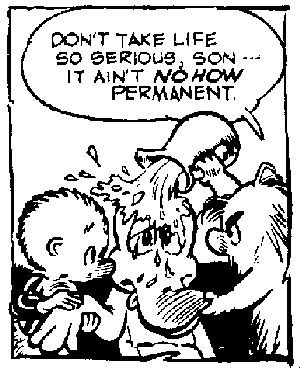
My new Twitter handle, which I'll probably dump in a week or two, is from Senator John Neely Kennedy (R-Louisiana), the tool with the Oxford doctorate, rubbery lips and finger-wave hair who pretends to be a folksy Walt Kelly character, looking like Porky Pine (above) and thinking like Senator Simple J. Malarkey (a sweaty caricature of Tailgunner Joe McCarthy), who's taken to ranting about "woke neosocialist cupcakes", and recently introduced the word "wokers", as in maybe "Wokers of the world, unite!" in this bizarre appearance with Sean Hannity:

Bow to the Wokers

by Senator John Neely Kennedy

I think they believe in open borders
That is very unfair — I mean, think about it.
We have Nigerian doctors and German engineers
who are following the law, they're waiting years
to be properly vetted, but yet President Biden
will allow any gangbanger who can cross the river
and jump the fence, he just says, 'Come on into America.'
It's also very dangerous. We don’t have the
slightest idea who's coming into our country.
But I don’t think the Biden Administration
will change because they prefer to bow
to the wokers and open borders as part
of the Woker Cupcake Bible. The wokers
honestly believe that venting people
at the border is racist. They honestly
believe that. And I know that sounds like —
that I am saying it, I am from Crazy
Town, but that is what they believe.

For the Record: Time for Another Blogger Ethics Panel

Press critic and hero of rectificationism Eric Boehlert of Media Matters and more recently his own bloggy Press Run, who died incomprehensibly on Monday in a bike collision with a train on the Montclair-Boonton line near his home in Montclair, New Jersey, at the age of 56. I'm feeling so bad about this. Photo from Salon.


Imagine seriously talking about "Why physics matter". What is a physic? (In old-fashioned medical practice, it's a medicine—"You must take some physic for that, my lord.") There's a suitable use for a singular "ethic" in modern English, as there is for "aesthetic", but "ethic" is isn't its plural; "an ethic" is ethics focused on a particularly narrow subject matter with a singular set of principles, where ethics is the broad discussion of all the different princples you might adopt.


Tuesday, April 5, 2022

Realism


Bucha, Ukraine, photo by AP via Arab News.

When I said I'd "loudly opposed" every US war since before Michael Tracey was born, I wasn't being totally honest, and I think I need to revise that a little: I didn't make as much noise over Grenada or Panama as I probably should have, because I expected them to end quickly and didn't think a lot of people would get hurt, in which opinion I was basically right, though of course every death is a bad thing (and estimates of Panamanian civilians killed run anywhere from 300 to 3,000, which would make it a lot worse than the way I remembered it), and I really didn't oppose the first Gulf War at all, not properly speaking.

Clausewitz was exactly wrong, as I've said before: politics is war continued by other means, not the other way around. And when the situation comes back down to war, that's a regression—a failure of politics; at least one of the parties blundered, and it shouldn't have happened. The Reagan and G.H.W. Bush administrations made a series of errors in encouraging and abetting Iraq's long and disastrous war on Iran, which left Iraq in a dire economic situation, hugely indebted to Kuwait and Saudi Arabia, even as Kuwait and Saudi Arabia were working with the US to keep oil prices low; and the Bush administration made a crucial error in 1990, in failing to make it known to Saddam Hussein that seizing Kuwait would bring a war on. It was a mistake similar in kind, if not degree, to the mistakes the World War I Allies made with Germany between 1919 and 1938.