Showing posts with label Ukraine. Show all posts

Monday, August 18, 2025

Speaking of Farces


The secret of his success is that it's a secret.

[image or embed]

— Yastreblyansky (@yastreblyansky.bsky.social) August 17, 2025 at 4:23 PM

Speaking of farces, there's a story about the origins of the Trump-Putin Alaska summit that started circulating a week or so ago in the German tabloid Bild: in Steve Witkoff's August 6 meeting with Putin, he came away with the impression that Putin was proposing to have Russian troops "peacefully withdraw" from the territories they've partly occupied in Kherson and Zaporizhzhia as part of a ceasefire agreement, in return for Ukraine leaving Russia in control of some territory they had held since 2014, maybe Donetsk: this would be the basis of Trump's claim on August 8 that there would "be some swapping of territories to the betterment of both."

Needless to say, this was not on offer; the best guess is that Putin said the Ukrainian troops could "withdraw peacefully" from Kherson and Zaporizhzhia and the Russians wouldn't attack them as they left, and Witkoff heard it wrong. By the time Trump spoke on the 8th (one of his deadline days for dealing out the "consequences" that Putin was supposed to suffer if he failed to agree to a ceasefire), Witkoff had spoken with European officials that morning and understood that he'd been mistaken and there was no chance of a deal, but the invitations had already gone out and been announced on Russian media. 

But it's not clear that anybody told Trump about that; he went through with plans for a festive breakthrough meeting in Anchorage, with the red carpet and military flyover, the tête-à-tête meeting between the two with only interpreters present (first time since Helsinki!), the luncheon "in honor of his excellency President Putin", and a nice tchotchke for the Russian leader, the "desk statue" of a bald eagle, and schedule featuring three Trump interviews for Fox News.

Sunday, December 8, 2024

Haute Diplomatie


Russia Pyotr Veliky missile cruiser makes port call in Tartus, Syria, 2023, via Countercurrents.

Let me get this straight? Trump dithers on about the situation in Syria and his concern is what's best for Russia?

[image or embed]

— Joyce White Vance (@joycewhitevance.bsky.social) December 8, 2024 at 8:31 AM

Here's the rest of it. It is ironic, of course, that he criticizes Obama for staying out of Syria and then calls for the same course of action. But his focus is on Russia. Not the US. Not the Syrian people. Russia.

[image or embed]

— Joyce White Vance (@joycewhitevance.bsky.social) December 8, 2024 at 8:33 AM

Couple of thoughts:

Obviously, Trump did not write this. The thinking is banal, but it's moderately complex and coherently designed toward a single main idea, as Vance notes, the question of how the Syria events will affect Russia. Completely different from Trump's "weave". Also not a subject to which our narcissist-in-chief is likely to devote that much consideration, with participants who aren't his own enemies—and while Russia might be considered one of his friends, he doesn't usually talk about his friends in this tone, as having made a mistake. He's usually "saying nice things" about his friends in return for their saying nice things about him, not speculating about them in this detached way.

Wednesday, February 21, 2024

A Little Night Narratology


Got fixated on a peculiar detail of the government case against Alexander Smirnov, the main witness in the Republican complaint according to which Hunter Biden and Joe Biden took $5 million each in bribes from Hunter's Ukrainian employer, Mykola Zlochevsky, and nobody else seems to be paying attention to it. 

Smirnov, a double agent working for Russian intelligence services and the FBI, gave the latter the story of the bribery, with advice as to how they could go about gathering evidence to back it up, and the Bureau gave it to Rep. James Comer and Senator Charles Grassley, who hoped to use it as a gigantic and appalling climax to their attempt to impeach the president, except, as we now know, when the special prosecutor found a moment to check the story out (34 months after receiving it), it turned out to be completely bogus, Smirnov's invention or that of his Russian handlers, and the Republicans' impeachment case, such as it was, is smashed to pieces, Smirnov is now under indictment for his deceit, and the prosecutor is trying to have him detained before trial, as a flight risk.  

It's in that document, special counsel David Weiss's request to deny bail to Smirnov, that the story of his collaboration with Russians emerged publicly for the first time, in the context of Weiss's long-delayed investigation of Smirnov's allegation—a story of Russian intelligence services promulgating disinformation to help elect Donald Trump to the presidency, which is, as you know, one of my favorite kinds of stories to tell, and the first big one of the 2024 campaign—so of course I was looking at it, and noticed this narrativium-packed paragraph (where Public Official 1 is the president and Businessperson 1 is his son):

Tuesday, June 20, 2023

Ukraine: What If They Win?


The Battle of Orsha, 1514, when Ukrainian and Lithuanian troops under Prince Kostyantyn Ostrozky stopped the westward advance of the Moscovites, from Serhii Plokhy's Lost Kingdom: The Quest For Empire and the Making of the Russian Nation, 2017.

Isaac Chotiner's New Yorker interview on the Ukraine counter-offensive with the war researcher Marina Miron—not one of his diabolical ones, when he utterly destroys the subject without their knowing it's happening—roused a lot of spite anyway, with her singularly lame-sounding comparison of the Ukrainian forces' situation, in whatever territory they succeed in taking back, to that of the American forces in Iraq around this time 20 years ago:

I’m referring back to Iraqi Freedom, the U.S. operation in 2003. The toppling of Saddam Hussein—the military part—had gone well. But the reconstruction part and governance itself was lacking, and that created a power vacuum. This is something that I think will also be needed in Ukraine once the Ukrainian troops hold those territories. They will need to hold those territories, and they will have to rebuild those territories.

I can imagine that the Russians who rule those territories have done quite a lot of psychological operations to sway the population, which speaks Russian and which is ethnically closer to Russia, to basically not mind being ruled by Russia, just as in Crimea. 

There was the question of what it means to be "ethnically close", and the question of whether linguistic affiliation is really such a vital issue—do we in the US want to be occupied by British troops? Does Ireland? A lot of people in Taiwan speak Mandarin—should that make it easier for Beijing to take over? Also, ethnic Ukrainians are substantial majorities in both Donetsk and Luhansk oblasts anyhow.

I suggested a Putinian argument for how to construct an analogy that might work:

Wednesday, May 10, 2023

Back in Ukraine


I don't regard Sushko, the Ukrainian racedriver turned advocate, as a reliable source of information— just because it's propaganda for an admirable cause doesn't mean it's not propaganda—but there, nevertheless, was Yevgeny Prigozhin, screaming at the Russian military in the most appalling language with a threat to pull his private army troops of the "Wagner Group" or "Wagner Orchestra" (honest to God, Оркестр Вагнера) out of the parts of Bakhmut it occupies, on May 10, the day after Russia celebrates the 78th anniversary of the German surrender, because his men aren't being supplied with adequate ammunition and are dying in excessive numbers; the suggestion is that the official Russian forces have changed their priorities from holding Bakhmut to coping with the coming Ukrainian spring offensive. 

Tuesday, October 25, 2022

October Surmise


This is kind of weird (and gets much weirder below the fold)—a letter to President Biden issued yesterday from 30 members of the House Progressive Caucus urging him, very respectfully, and without any cheap bothsidesing of the respective positions of Ukraine and Russia, to work toward a negotiated settlement of the Ukraine war, mainly reacting to the scarily increased risk of nuclear conflict:

Given the destruction created by this war for Ukraine and the world, as well as the risk of catastrophic escalation, we also believe it is in the interests of Ukraine, the United States, and the world to avoid a prolonged conflict. For this reason, we urge you to pair the military and economic support the United States has provided to Ukraine with a proactive diplomatic push, redoubling efforts to seek a realistic framework for a ceasefire. This is consistent with your recognition that “there’s going to have to be a negotiated settlement here,” and your concern that Vladimir Putin “doesn't have a way out right now, and I'm trying to figure out what we do about that.” 

We are under no illusions regarding the difficulties involved in engaging Russia given its outrageous and illegal invasion of Ukraine and its decision to make additional illegal annexations of Ukrainian territory. However, if there is a way to end the war while preserving a free and independent Ukraine, it is America’s responsibility to pursue every diplomatic avenue to support such a solution that is acceptable to the people of Ukraine.

I wouldn't sign it myself—looks like a signal of doubt and disagreement among Democrats that I don't think it's helpful for Russians to see, and then I'm pretty confident that whatever negotiation with Russia is possible right now is being done anyway, not just by US but NATO as a whole, maybe with Türkiye (formerly known as Turkey) in the lead—but it's really hard to object to the substance of the thing, such as it is ("Mr. President, please do what I think you're doing"). But why, and why now?

Thursday, October 13, 2022

Thy Hand, Great Anarch! Two kinds of stupid


I

Apparently President Putin has spent the last four days raining death and destruction on Ukrainian civilians not because it's some kind of military strategy—wrong, it's of no strategic value at all—and also not because he just has too much weaponry and is trying to use it up, like trad Catholics using up all the animal fat in the house on Pancake Tuesday, but out of fear of people in his orbit who are even more rabid than he is. It's the "more serious" response he was promising last month if Ukraine continued refusing to be conquered:

“Recently, the Russian armed forces have inflicted a couple of sensitive blows. Let’s assume they’re a warning. If the situation continues to develop like this, then the response will be more serious,” he said.

Though there's nothing serious about it, other than that he seems to be seriously afraid of his own puppets:

Tuesday, April 5, 2022

Realism


Bucha, Ukraine, photo by AP via Arab News.

When I said I'd "loudly opposed" every US war since before Michael Tracey was born, I wasn't being totally honest, and I think I need to revise that a little: I didn't make as much noise over Grenada or Panama as I probably should have, because I expected them to end quickly and didn't think a lot of people would get hurt, in which opinion I was basically right, though of course every death is a bad thing (and estimates of Panamanian civilians killed run anywhere from 300 to 3,000, which would make it a lot worse than the way I remembered it), and I really didn't oppose the first Gulf War at all, not properly speaking.

Clausewitz was exactly wrong, as I've said before: politics is war continued by other means, not the other way around. And when the situation comes back down to war, that's a regression—a failure of politics; at least one of the parties blundered, and it shouldn't have happened. The Reagan and G.H.W. Bush administrations made a series of errors in encouraging and abetting Iraq's long and disastrous war on Iran, which left Iraq in a dire economic situation, hugely indebted to Kuwait and Saudi Arabia, even as Kuwait and Saudi Arabia were working with the US to keep oil prices low; and the Bush administration made a crucial error in 1990, in failing to make it known to Saddam Hussein that seizing Kuwait would bring a war on. It was a mistake similar in kind, if not degree, to the mistakes the World War I Allies made with Germany between 1919 and 1938.

Monday, April 4, 2022

For the Record: Tracey on War

Via Wonkette.


I completely forgot Tracey was complaining about unfairness to Russia way back five years ago, that time Maxine Waters beat him up.


Friday, March 25, 2022

News From Russia


Lawrence Sheets, who used to be NPR's Moscow bureau chief 20 or so years ago, now president of Eurasian International Analytics LLC, whatever that is, has recently been holed up in Odessa watching TV—not Ukrainian TV, but Russian, the 9:00 national news show Vremya, which he thinks has been turning pretty weird. He offered up some observations on it last week in Politico, and showed up with a follow-up on the radio this morning.

He thinks the show is getting very frayed, not quite professional in production, and not coherent in message, and of course the coverage on the Ukraine "special military operation" is full of lies, but he thinks the message has been shifting in significant ways: the "Ukraine is run by Nazis" theme is falling into disuse, the theme of "Ukrainians are bombing their own civilians to make Russia look bad" is getting more play (indicating, I'd think, that more and more Russians are seeing video of the massive destruction in Kharkiv and Mariupol and so on, with their VPNs, and the authorities feel they have to provide some explanation for it).

And the paranoia is getting really baroque: it's now asserted that Hunter Biden and his laptops are or were personally in charge of the imaginary US-Ukraine program for developing biological weapons of mass destruction (remember when the word was that Hunter's simply getting a job was evidence of corruption, because he was obviously too incompetent to do a job of any sort? Now he's Dr. von Doom), and everybody's favorite Elder of Zion, George Soros, is of course behind it all. 

Which is also a big thing, I've learned from Twitter, among the American Putinists:

Wednesday, March 9, 2022

U.S. Humanitarian Relief for Ukrainians in the Wake of Russian Invasion

A Ukrainian woman reacts after arriving at the Medyka border crossing, in Poland, Sunday, Feb. 27, 2022.  Since Russia launched its offensive on Ukraine, more than 200,000 people have been forced to flee the Country to bordering nations like Romania, Poland, Hungary, Moldova, and the Czech Republic — in what the U.N. refugee agency, UNHCR, said will have “devastating humanitarian consequences” on civilians. (AP Photo/Visar Kryeziu) (Fair Use)

Most of the World has been horrified by the Russian invasion of Ukraine, a sovereign nation that posed no threat whatsoever to the Russian Federation.  The U.N. estimates that two million refugees have already fled Ukraine.  While preliminary reports suggested that the total number of refugees could be as high as five million, I believe the number will be much, much higher as the fighting continues and Russian forces target civilians. U.S. sees 'very credible reports' of deliberate attacks on civilians in Ukraine.

The United States has helped organize a strong, united response to this Russian aggression. Still, it has only begun to consider what steps it will take to protect the countless citizens of Ukraine fleeing the violence or who have found themselves stranded overseas when the invasion started.

This post will discuss the most recent aid developments and the options that Ukrainians have, depending on where they are and what their current U.S. immigration "status" is.

Tuesday, March 1, 2022

If You Want to Sit on a Hedgehog You Should Keep Your Pants on. And Other Lessons of Ukrainian History


Ilya Repin, Reply of the Zaporozhian Cossacks, 1880-91, from the Yorck Project (2002) 10.000 Meisterwerke der Malerei (DVD-ROM), via Wikipedia.

Yglesias yesterday, talking about the irony of American Jews whose ancestors emigrated from Ukraine, fleeing the draft (if they picked you, you served 25 years) and the pogroms by murderous Cossacks, now identifying as Ukrainians themselves:

Monday, February 28, 2022

Note on Whataboutism

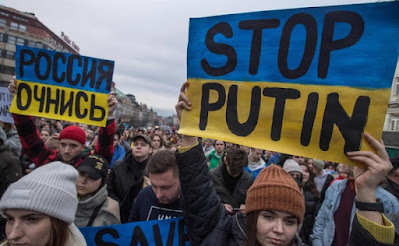
Protesters in Venceslas Square, Prague. Photo by AFP-Yonhap via The Korea Times. It's getting very international.


Wild day yesterday, starting with the radio news that President Zelenskyy had rejected a Russian request to start peace negotiations in Belarus (Belarus, he said, was contributing to the Russian invasion and wasn't a neutral country) and going on to the news that he'd changed his mind after a call from President Lukashenka assuring him that Belarus would not be sending any missiles, planes, or helicopters across the border as long as the talks went on: 

“I will say frankly that I do not really believe in the outcome of this meeting, but let them try to make sure that no citizen of Ukraine has any doubt that I, as a president, did not try to stop the war,” Mr. Zelensky said.

Meanwhile, Russia's diplomatic isolation continued to grow: Germany announced that it would reverse decades-old policy and start contributing lethal assistance to Ukraine—antitank missiles and Stingers—and the chorus of countries ready to cut Russia out of the Swift bank transfer system grew to include Japan and Hungary. Europe and Canada joined to ban Russian planes from their airspace. As I noted yesterday, important classical music figures like Putin's pal Valery Gergiev are unable to perform outside Russia; the national Polish and Swedish soccer teams are likewise refusing to play against Russia in the World Cup heats. Ukraine filed criminal charges against Russia in the International Criminal Court, and demanded Russia's expulsion from the United Nations Security Council (no, that's not going to happen). Switzerland—Switzerland!—has tossed its I-don't-know-how-many-centuries tradition of unbreakable neutrality and joined the EU in imposing financial sanctions on Russia, and may even be sending weapons. Oil monster BP is outright dumping a $25-billion stake in Rosneft:

Saturday, February 26, 2022

What Did You Do in the War, Dad?

I won the war against Russian fascism last night, going to my first concert since 2019: brother-in-law's brother-in-law had tickets to the Vienna Philharmonic at Carnegie Hall and couldn't go, so he passed them to me, and I was feeling kind of funny about going, because the conductor was Valery Gergiev, longtime artistic director of the Mariinsky Theater in St. Petersburg, where he became friends with the then deputy mayor, Vladimir Vladimirovich Putin, in 1992, which has been pretty good for his career (he's been the third wealthiest Russian on the Forbes list of celebrities), but it hasn't been so good for his reputation internationally when he's appeared in Putin's campaign ads, denounced the members of the Pussy Riot group, or failed to address the Russian "gay propaganda" law of 2013 making it a crime to distribute "propaganda of non-traditional sexual relationships", which has led to protests when he appears in New York, one of which I witnessed a while back (I felt like I was crossing a picket line), as well as dark questions about the relationship between art and power, as Alex Ross (whose account I am shamelessly stealing from here) told New Yorker readers in reference to a 2013 Gergiev performance of Dmitry Shostakovich's 8th symphony:

We have read many accounts of Shostakovich’s life under Stalin, his terror-stricken accommodations with the Soviet state. How should we react when this composer’s music is led by a conductor who has entered his own pact with authority, who has even spoken approvingly of the politics of fear? There is no clear answer to that question. We have all made our compromises with power; everywhere, the noblest artistic strivings are circumscribed by social conditions that make them look hypocritical and hollow. But the historical ironies surrounding Valery Gergiev are becoming uncomfortably intense.

Anyway, in the end, I got to go to the concert and Gergiev didn't get to conduct it. I should have known—it was reported in The Times on Thursday: Gergiev is canceled. 

Vienna dumped him for the orchestra's current US tour, he's losing gigs in Milan and perhaps Munich and Rotterdam, and last night he was replaced by the genial Canadian Yannick Nézet-Séguin, music director of the Metropolitan Opera, while the very young Korean pianist Seong-Jin Cho stepped in for the Russian Denis Matsuev (who has expressed support for the annexation of Crimea). It was a kind of schlocky program but one that goes beautifully with the famous warmth and richness of the Vienna band and the Carnegie acoustics, of the two most warhorsy of Rachmaninov's warhorses, the second piano concerto and second symphony, and it worked really really well.

It also started really late, I guess because we had to enter in single file in a line stretching almost around the block as everybody's vaccination status was verified, and it wasn't surprising at the end when Nézet-Séguin turned to the audience and said, "You want an encore? Come back tomorrow night!" It was a giddy, funny moment, and it honestly did feel like a feeling of victory for Ukraine, leaving us tired and a little punch-drunk but happy, as if we actually had been at a well-fought battle, against the grim forces trying to overwhelm us in this dark time.

Friday, February 25, 2022

From Psychopathy to Psychosis

Miniature from the 15th-century Radziwiłł Chronicle history of Kievan Rus', showing Vladimir I of Kiyiv threatening to kill his consort Rogneda of Polotsk, while their son Prince Izyaslav defends her. Via Wikimedia Commons.

We all know about Lord Acton and that thing that power does and absolute power does absolutely, which certainly applies to President Putin, but there's something even more dangerous than that: power gives you a false sense, overconfidence bias, that you know what's going on, absolute power makes you delusional. 

Seva Gunitsky is one of the authors, with Adam Casey, of a piece that appeared three weeks ago in Foreign Affairs that I wish I'd seen before I started making predictions about Ukraine, "The Bully in the Bubble: Putin and the Perils of Information Isolation", the burden of which is that Putin, like Xi Jinping, Nicolás Maduro, Recep Tayyib Erdoğan, and a scarily increasing host of others, practices what the authors call a "personalist" rule, in which government proceeds not from an ideological framework or a particular power/interest structure but simply from one person, not just an autocrat, but one focused on acting out his own needs and desires, whatever they may be. Trump is inclined to be a personalist too, which is what his authoritarian party hired him for, but he's too personally incompetent to actually carry the thing out; Putin has seemed to us to be the super-competent opposite, a kind of Lord Vetinari, the skilled and efficient Patrician of Ankh-Morpork, trained assassin and polymath, master of detail, only much nastier of course. But on Earth, as opposed to Discworld, even the most able personalist ruler faces pitfalls that are nearly impossible to escape:

Tuesday, February 15, 2022

Joe Did What? The Second Time Around


Imagery of a war scare.

Yesterday on NPR, when I was half asleep during an interview with the career diplomat John Herbst, who was ambassador to Ukraine from 2003 to 2006 and now runs the Atlantic Council's Eurasia Center, I heard a reference to something like "the last time Russian troops surrounded Ukraine and an invasion seemed imminent, in April 2021,"  and I was kind of wait, what?

Because that's less than a year ago, and I don't remember anything about it, and almost nobody else does either, as far as I can tell, and I really don't think it was widely reported in the US. When I finally got around to looking it up, Dr. Google sent me, not to The New York Times or Washington Post, but the Natsional'nyy Instytut Strategichnykh Doslidzhen' (National Institute of Strategic Studies, and I'm not sure I'm transliterating it right) in Kiyiv, which has an excellent report on "The Russian and Ukrainian Spring 2021 War Scare", in English, that tells me more or less what I needed to know: In March 2021 Ukrainian intelligence were alarmed by an unusual concentration of Russian troops and hardware forming along the Russian-Ukrainian border, and at the end of the month the US European Command raised its alertness leve from "possible crisis" to "potential imminent crisis". 

Saturday, February 12, 2022

War News


Pine forest near Klavdievo, Borodianka Raion, Kyiv Oblast, Ukraine. Photo by Aymayna Khikari via Wikimedia Commons.

Thursday, February 3, 2022

Ukraine Blogging


Weird message from Mr. Tucker Carlson a while back that was tagged by some observers, I think correctly, as of Russian origin:

It's easy to call it propaganda, but I'm finding myself inclined to think of it as something a little bit different, really a message from Putin, one in the Whataboutist mode, seriously, asking for just a little understanding, bro—the Russian Federation really is kind of surrounded on its west, by NATO members some of which control nuclear weapons, all along the western borders of Russia or Belarus or Ukraine from Estonia to Turkey, from the north end of the Gulf of Finland to the eastern end of the Black Sea, members of an alliance that was specifically designed 70-odd years ago to thwart Russian movements in that direction. 

Tuesday, January 11, 2022

For the Record: Pipeline Talk


Getting Russian natural gas to Europe, via Radio Free Europe. It'l be a lot less complicated once Europe stops using natural gas—may it be soon!—but in the meantime, the Ukraine (the purple line) is not getting replaced...

And now for something completely different: