Showing posts sorted by relevance for query brooks meritocracy. Sort by date Show all posts

Saturday, January 13, 2018

I love a mystery

Drawing by Barry Deutsch, via Bicultural Familia.

Meritocracy (merit, from Latin mereō, and -cracy, from Ancient Greek κράτος kratos "strength, power") is a political philosophy which holds that certain things, such as economic goods or power, should be vested in individuals on the basis of talent. Advancement in such a system is based on performance, as measured through examination or demonstrated achievement.
The Rise of the Meritocracy is a satirical novel by British sociologist and politician Michael Young which was first published in 1958. It describes a dystopian society in a future United Kingdom in which intelligence and merit have become the central tenet of society, replacing previous divisions of social class and creating a society stratified between a merited power holding elite and a disenfranchised underclass of the less merited. The essay satirised the Tripartite System of education that was being practised at the time.[1]
Meritocracy is the political philosophy in which political influence is assigned largely according to the intellectual talent and achievement of the individual. Michael Young coined the term, formed by combining the Latin root "mereō" and Ancient Greek suffix "cracy", in his [writing,] to describe and ridicule such a society, the selective education system that was the Tripartite System, and the philosophy in general.

We've often seen David Brooks inveighing against "meritocracy", and it really is mysterious, as Jordan noted in comments earlier today. Not mysterious that he should be against meritocracy, at least in the allocation of political power, which I think should be regarded as basic democracy, neither left nor right: there's no legitimate power above the people that's entitled to set an exam for who's going to represent us, I'm against that too—but that he should be convinced that it exists in the United States (outside of the civil service, which has used meritocratic principles very successfully since the 1883 reform, and is not something David Brooks has ever shown any interest in), and it really makes him angry, as something crass, utilitarian, not quite decent, as in these passages from The Road to Character:

Saturday, September 14, 2019

This is not the way to bring an end to class

This is not the way to bring an end to the class system.

Shorter David Brooks, "The Meritocracy Is Ripping America Apart: How Savage Exclusion Tears the Social Fabric", New York Times, 13 September 2019:
Hey, guys, it turns out inequality is really bad! Not only for you and me and the rest of the great mediocre majority who never get a chance to rule the world, but even for the brilliant Ivy-trained wizards who do rule it! They have to work too hard, and it's ruining their lives! Meanwhile, I've learned that there are these things called state universities! They have one in Arizona! I got to visit it last spring and it knocked my socks off. Instead of doing all they can to keep people out, they keep trying to get more people in, and instead of getting worse from letting all those mediocre people in, it gets better. This could be a game-changer!
He's come to some clarity on the subject of what it is he hates about meritocracy, thanks to the book Brooksy has read the first 20 pages of for Friday's column, The Meritocracy Trap: How America's Foundational Myth Feeds Inequality, Dismantles the Middle Class, and Devours the Elite, by Daniel Markovits, a Yale law professor who is, according to the publisher blurb, "well placed to expose the sham of meritocracy. Having spent his life at elite universities, he knows from the inside the corrosive system we are trapped within." Well, speak for yourself, pal. If the rest of us peasants only know if from the outside, then we're not trapped within it. And if we're all trapped within it, then his experience isn't that special.

As a matter of fact it sounds like a pretty fierce indictment of something. As Thomas Frank writes, reviewing the book for The Times,

Tuesday, December 12, 2017

Gleichschaltung

Gleichschaltung der Kulturen. Drawing, 2003, by Walter Wesinger ("Waldah"), via staatenlosinfo,org.

David Brooks ("What's Wrong With Radicalism") in the grips of a kind of interesting thought today: that the policies promoted by our two big political parties aren't really very radical:

Stylistically and culturally, Trumpian populism screams “blow it up” and “drain the swamp.” But Donald Trump’s actual policies are run-of-the-mill corporatist. The left-wing radicals talk a lot against the systems of oppression and an institutionalized injustice. But they are nothing like the radicals of the 1930s or the 1960s.

Today’s radicals do not want to upend the meritocracy, which is creating a caste system of inherited inequality. They don’t want to stop technical innovation, which is displacing millions of workers. They don’t have plans to reverse individualism, which atomizes society and destroys community. A $15 minimum wage may be left wing, but it’s not Marxist-Leninism.
If that's true, then isn't Brooks's whole shtik misplaced? He's been telling us for ten years that we need to situate ourselves humbly in the sweet, quiet spot between the extremes of left and right; now he's saying we're already there, but it's so noisy in here we don't realize it? Or what?

No,

Friday, May 27, 2016

David Brooks penetrates the student movement. Well, not quite.

Image via Amazon Fashion.
David Brooks is jumping today ("Inside Student Radicalism") into the rightwing crowd howling around Nathan Heller's "Letter from Oberlin" on the perils of intersectionality in the little to medium-sized private liberal arts college, in the current New Yorker, which offers many hilarious examples of campus excess, the student who wanted trigger warnings posted for Sophocles's Antigone (students could be affected by the heroine's argument in favor of suicide), or the theater professor who slipped on a Groucho Marx nose or something like it ("a rubber nose and glasses") during an interview, while Heller wasn't looking ("a grown man, having a meeting with a reporter from The New Yorker, behaving that way", shrieks Rod Dreher, who will certainly behave with the utmost sobriety if a New Yorker reporter ever interviews him), or the president who likes to talk over issues with students over ice cream, because "There is nothing like ice cream to bring people together".

(For Dreher, that function is better filled by "a salade gourmande, which was a green salad with haricots verts (those matchstick-thin French green beans), fresh mushrooms, in a mustard vinaigrette, with a side slab of pâte de foie gras" to start, followed by chicken in a creamy sauce with fresh morels. It's astonishing, by the way, what a timid Anglo eater Dreher is, considering how sophisticated he thinks he is, ordering the chicken in Lyon where he's afraid to try tripe, andouillettes—the man is from Louisiana!—or even the house specialty of pike quenelles. And he believes tripe [stomach lining] and chitlins [small intestine] are the same thing, the ignoramus.)

Monday, August 2, 2021

SocioLOLogy

Jerry Lewis and Stella Stevens in The Nutty Professor, 1963. Via Wikipedia.

Thing I learned: the word "bobo", a contraction of "bourgeois-Bohemian" apparently coined by David Brooks in his amusing 2000 sociological bestseller Bobos in Paradise: The New Upper Class and How They Got There, grew extremely big in France (and Québec), even as it never caught on in the US. 

Brooks himself didn't have anything particularly ambitious in mind, as he pointed out in his preface, partly because he didn't have any particular knowledge of how to practice sociology, or any interest in learning how:

There aren't a lot of statistics in these pages. There's not much theory. Max Weber has nothing to worry about from me. I just went out and tried to describe how people are living, using a method that might best be described as comic sociology. The idea is to get at the essence of cultural patterns, getting the flavor of the times without trying to pin it down with meticulous exactitude. Often I make fun of the social manners of my class (I sometimes think I've made a whole career out of self-loathing), but on balance I emerge as a defender of the Bobo culture. In any case, this new establishment is going to be setting the tone for a long time to come, so we might as well understand it and deal with it.

Just as the fraudulent psychic Sibyl Trelawney in the Harry Potter books does at one point manage involuntarily to do a real prophecy, Brooks in his career has done one actual creative thing, the invention of the bobo concept; but it was just a little comic sociology, nothing pretentious, except for the interesting claim, which I'll get back to, that he's a bobo himself ("my class" for which he advertises his "self-loathing", the "creative class" as he often calls it, following Richard Florida, the holders of "intellectual capital"), even though there was nothing even slightly Bohemian about his life at the time, living in a suburban house in Bethesda with the stay-at-home wife and kids, attending a Conservative shul on Saturdays, writing for Kristol's Weekly Standard, and wearing a suit on PBS. While very much something of belonging to a "new establishment" as he cheered on the electoral triumph of the neoconservatives under George W. Bush the year the book came out, and the advent of the Iraq War.

Saturday, January 13, 2018

The Main Cause of the Badness

From Sergei Eisenstein's ¡Qué Viva México!, 1933, via Screen Dance Studies.

Looking for David Brooks's column in yesterday morning's Times, I found a whimper with a headline so stale and dispirited ("How Democracies Perish") that I thought I must be looking at an old column I'd dealt with already, and figured he'd taken the whole Martin Luther King, Jr. weekend off.

As it turned out, of course, the title was so familiar because it was ripped off, from a book that's to be released on Tuesday and is already being talked about, Steven Levitsky's and Daniel Ziblatt's How Democracies Die, an assessment of the present danger to democracy, such as it is, in the United States. Brooks had written a new column—it merely looked like an old one, which isn't that unusual—and it's not totally boring, once you get down inside. Not that he's writing about Levitsky's and Ziblatt's book or even aware that he's indirectly referencing it; he's on the new book with a melancholy title that came out last week:

Saturday, April 18, 2015

A softening in the moral sphere

Image of Louise Brooks as Lulu in the G.W. Pabst film of Die Büchse der Pandora (1929), from a time of moral softening, when a narcissistic and relativistic generation replaced the modest and self-sacrificing folks who brought us World War I. Or was that the 14th century? Who knows, I have a deadline.
Shorter David Brooks, "When Cultures Shift", New York Times, April 17 2015:
In the course of my research for THIS BOOK I'VE BEEN WRITING NOT THAT I CARE IF YOU LOOK AT IT OR ANYTHING BUT IT JUST CAME OUT I learned, surprisingly, that the 1960s actually started in the 1940s. That's just the kind of remarkable contrarian stuff that you can find out if you stick with me.

Friday, April 26, 2019

Brooks on Biden


I may be pissed off with Biden, but I'll defend him to the death against the woozy admiration of David F. Brooks, who sees the Biden candidacy as part of the battle against meritocracy ("Your Average American Joe"):
Other people may claim to be populist in their policies — and because they are “right” on those, they are allowed to be contemptuous toward those who are less enlightened. Biden is a populist in his person and makeup — where he comes from and how he relates.
Joe's just a creature of intuition, not thought—a lovely, sweet-natured beast who will never make David Brooks feel ill-educated or inferior, as some unnamed person apparently does (Warren? Is that a backhanded reference to Warren?), piping his native wood-notes wild. You might think policy kinds of things would be important to somebody who's interested in governing, but then you might just be one of those elitists; simple-minded Joe understands that governing isn't a matter of gathering a bunch of extrinsic ideas but of being the right sort of person:

Tuesday, July 24, 2018

Concerned

Drawing by Roz Chast, via Fine Art America.


Concern troll David Brooks is concerned today about the narratology ("What Is the Democratic Story?"):
There’s a lot of discussion about how far left the Democratic Party should go these days. Is it destroying its electoral chances when its members call for a single-payer health plan or abolishing ICE?
That’s an important question, but the most important question is what story is the Democratic Party telling? As Alasdair MacIntyre argued many years ago, you can’t know what to do unless you know what story you are a part of. Story is more important than policies.
Ah, a name—a clue, perhaps, to whatever it is Brooks has been doing wrong with this concept. Alasdair MacIntyre (b.1929), Dr. Google tells me, is a Scottish moral philosopher, a Thomist in his ultimate phase starting in the late 1970s, interested in

Tuesday, September 27, 2016

Give me that old-time conservatism, it's good enough for me

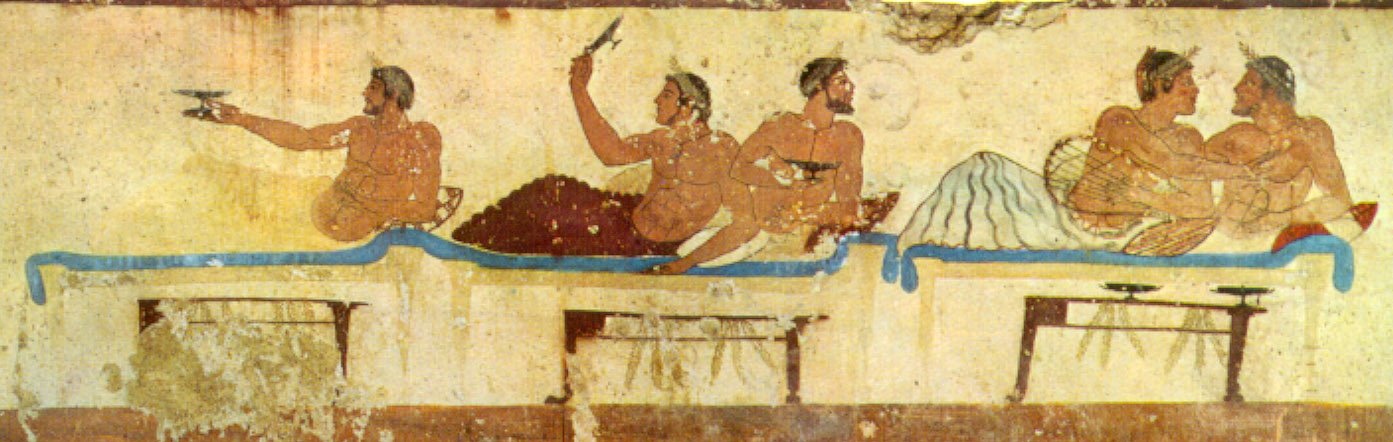
Typical symposium, from the Diver's Tomb at Paestum, Campania, ca. 475 B.C.E., or about 60 years before the poet Agathon threw the unforgettable party, after his victory in the playwrights' competition in the Dionysia of 416, that Plato (who wasn't there) dramatized in his great Symposium three or so decades afterwards. Via Wikipedia. You guys on the right get a room, for Apollo's sake!
Shorter David Brooks, "The Age of Reaction", September 27 2016:
The real problem is the crappy conservatives we have nowadays. Conservatives in my time used to be people you could look up to, with positive ideas, moderate but optimistic religiosity like Dr. Martin Luther King, Jr., and a humanistic appreciation for progress, and now they're all nothing but a bunch of reactionaries. These kids make me sick.
So he's a kind of meta-reactionary himself, yearning to go back to when the conservatives were the right, clubbable sort. That's after castigating Hillary Clinton on Friday for being mired in the tired ideas of the 20th century.

Obviously I'm psyched about the debate, but everybody's writing great stuff about it, and I was really busy all day, and here's Brooks, and this strange doom of mine to deal with him week after week. There's a couple of laughs coming, in any event.

It's book report day at Brooks's shop. He must have had to file early yesterday afternoon so he could get over to the PBS studio for the Great Debate, where he was needed to deliver such deathless insights as

Saturday, April 25, 2015

Love and Merit, Love and Merit

Go together like a Stick and Carrot?

Lon Chaney and Mary Philibin in The Phantom of the Opera (1925). Via PaxRomano.
The Sage of Cleveland Park may have arrived at the stage of blaming Dad, who always liked you better than me, for why he's so fucked up:
Verbatim David Brooks, "Love and Merit", New York Times, April 24 2015:
Parents unconsciously shape their smiles and frowns to steer their children toward behavior they think will lead to achievement. Parents glow with extra fervor when their child studies hard, practices hard, wins first place, gets into a prestigious college. This sort of love is merit based. It is not simply: I love you. It is, I love you when you stay on my balance beam. I shower you with praise and care when you’re on my beam. The wolf of conditional love is lurking in these homes.
Or maybe he's having a fight with his own kids who complain that he always made them feel worthless by not praising them and he's trying to make an argument that it was for good reasons, not that he just wasn't paying attention. (The acknowledgments to The Road to Character say "My ex-wife, Sarah, has done and continues to do an amazing job raising our three children", suggesting he himself has rarely seen them at all, at least until they started showing up dressed for dinner instead of being put to bed during the cocktail hour.)

Tuesday, June 18, 2019

Brooks on Harvard

Reading Room, Langdell Hall, Photo by John Phelan via Wikimedia Commons.

An interesting take from moral philosopher David F. Brooks ("Harvard's False Path to Wisdom") on the case of Kyle Kashuv, the gun nut Trump acolyte among the survivors of the Marjorie Stoneman Douglas high school shooting, whose Harvard acceptance has been rescinded after the discovery of some extremely offensive text messages and other communications he wrote "years ago", in his words, or in some cases 18 months, as in the below example (via Steve M):


Most conservative commentators focused on the unfairness of Harvard's decision, as Ben Shapiro, a mentor of Kashuv's, described it:  "Harvard's auto-da-fe sets up an insane, cruel standard no one can possibly meet", because who among us has not as a teenager typed things like this?

Saturday, November 17, 2018

The Unbearable Whiteness of Chicory

Belgian endive.
One of the conservative voices I know of who can write a truly decent paragraph and show some genuine human feeling, at the same time, is Anne Applebaum, an American journalist married to the Polish politician Radosław Sikorski, who had a beautiful, colossally sad essay ("A Warning From Europe") in last month's Atlantic about crazy nationalism as it's expressing itself in Central Europe at the moment, particularly in Poland and Hungary, which is in some ways scarier, if only because of its echoes of a familiar 1930s and 40s, than the comical goings-on in Trumpy America or the infuriating stupidity of Brexit Britain—if you think I'm crazy to keep associating conspiracy theories about George Soros with traditional Protocols-of-the-Elders anti-Semitism, you just need to be looking at the anti-Soros propaganda coming from Soros's native Hungary, where they make it very explicit (and where Trump adviser Dr. Sebastian Gorka, member of a "Historical Order of Vitéz" reviving the Nazi-run Order of Vitéz of the interbellum era, got his doctorate at the sadly decayed Corvinus University). In Poland especially, where the Velvet Revolutions of 1989 took a particularly legitimate conservative form,  Catholic, under the influence of John Paul II and union leader Lech Wałęsa, Applebaum describes a wrenching split between what I almost want to call leftist conservatives, the European-minded, artistically and philosophically sophisticated, conservative mainly in a kind of sweet upper-class cluelessness that really doesn't mean any harm, and the ruthlessly careerist nationalists of the Kaczyński faction, dividing families and marriages, and wrecking friendships she herself has had for decades, but worse than that is the damage that the nationalists are industriously making.

So here's David F. Brooks to supply the tl;dr on that ("The Rise of the Resentniks") by way of applying it to the Americans and, presumably, soak up some of that pity I can't help feeling for the Sikorski-Applebaums of the world:

Monday, September 26, 2016

Twentieth-Century Box

One of Hillary Clinton's old-fashioned, 20th-century celebrity endorsers, like Streisand and Cher. Photo by Ramona Rosales via Billboard.

Oops, I forgot all about David Brooks and his Friday column ("The Clinton Calendar")! And now there are fine posts out by Steve and Driftglass and Bethesda 1971. And here's Dr. Krugman, as usual not referring to Brooks by name but as "pundits":

Here’s what happens every election cycle: pundits demand that politicians offer the country new ideas. Then, if and when a candidate actually does propose innovative policies, the news media pays little attention, chasing scandals or, all too often, fake scandals instead. Remember the extensive coverage last month, when Hillary Clinton laid out an ambitious mental health agenda? Neither do I.
For that matter, even the demand for new ideas is highly questionable, since there are plenty of good old ideas that haven’t been put into effect. Most advanced countries implemented some form of guaranteed health coverage decades if not generations ago. Does this mean that we should dismiss Obamacare as no big deal, since it’s just implementing a tired old agenda? The 20 million Americans who gained health coverage would beg to differ.
That's a direct response to Brooks's complaint on Friday that Clinton had failed to join us here in the 21st century:

Tuesday, July 28, 2015

The Structure of Platitude

Welcome MBRU readers!
"Gratitude is a sort of laughter of the heart."
David Brooks

"Lolwut?"
—me
Mary Pickford and Howard Ralston in Paul Powell's Pollyanna (1920).
Brooks in briefs and undershirt, crawling along the baseboard in search of a powerpoint for his laptop.
Hotel rooms, amirite? Can't live in 'em, can't live outside of 'em. They'll give you an iron just in case the one-hour laundry service doesn't do a good enough job with your shirt, but you can't find a fvcking outlet to plug it into. Maybe I could work that up for a column.
Finds it, sighs, sets up the charger, looks out the window.
Still, I could be in that breakfast bar in Michigan fighting over the self-service waffle maker. At least there's room service here, even if the waiter's shirt is better pressed than mine. I should be more grateful.
Sits at the machine.
Some are born grateful, some achieve gratefulness, some have gratitude thrust upon them. Hm.

Saturday, March 16, 2019

The End of Meritocracy

Architects' rendering of plans for a parking lot in Harvard Yard. Just kidding: prank picture from the Harvard Satyrical Press, March 2009, attributed to the Committee For Endowment Preservation by Any Means Necessary.

Looks like the competition for which New York Times opinionist will be first to come out in defense of the millionaires who bribed their kids into Stanford and USC has a winner, and it's not David Brooks, as I was predicting—

—or Bari Weiss, but Harvard's finest, Monsignor Ross Douthat, Apostolic Nuncio to 42nd Street ("The Scandals of Meritocracy"). Oh, he doesn't quite come out and say it, and he adds a trollish recommendation for racial quotas just to keep you confused as to whether he's joking or not, but I think that's what it is:
The “more meritocracy” argument against both legacies and racial quotas implicitly assumes that aptitude — some elixir of I.Q. and work ethic — is what our elite primarily lacks.
But is that really our upper class’s problem? What if our elite is already diligent and how-do-you-like-them-apples smaht — the average SAT score for the Harvard class of 2022 is a robust 1512 — and deficient primarily in memory and obligation, wisdom and service and patriotism?
In that case continuity and representation, as embodied by legacy admissions and racial quotas, might actually be better legitimizers for elite universities to cultivate than the spirit of talent-über-alles. It might be better if more Ivy League students thought of themselves as representatives of groups and heirs of family obligation than as Promethean Talents elevated by their own amazing native gifts.
That's extremely interesting, the view of what problem "meritocracy" is supposed to solve, the problem of practical improvement, or building an elite of higher quality.

I mean interesting to me, at least, because I've literally never thought of it before, not that it doesn't make some kind of chilly sense.

Friday, April 17, 2020

Harrumph


That's what causes the spread of disease, allowing these ruffians to go on breaks. Meanwhile David Brooks is taking a big break from the watery cosplay compassion of his Weavery and letting the real Brooks out of the house with a big Tory Harrumph ("The Age of Coddling Is Over"):
Over the past decades, a tide of “safetyism” has crept over American society. As Greg Lukianoff and Jonathan Haidt put it in their book “The Coddling of the American Mind,” this is the mentality that whatever doesn’t kill you makes you weaker. The goal is to eliminate any stress or hardship a child might encounter, so he or she won’t be wounded by it.
("The Untruth of Fragility: Whatever Doesn't Kill You Makes You Weaker" is the title of chapter 1 of the Lukianoff-Haidt book, so now we know pretty much exactly how far Brooks got reading it; he doesn't believe in coddling authors either.)

Not only is this indulgence of the little ones ridiculous, it also causes suicide and mental illness:

Tuesday, May 29, 2018

Merit Badge

The summer 2017 intrern class. Photo by Pedro Martínez Monsivais/AP, via Glamour.
Shorter David Brooks. "The Strange Failure of the Educated Elite", New York Times, 28 May 2018:
Now that we're ruled by a new aristocracy of merit, the smartest people with the highest IQs and of all colors and genders and committed to equality and recycling, things are really going badly, with inequality rising and social trust decreasing and government not working at all. What on earth happened? As I've been saying for 20 years, like the books I enjoy, which are the books that agree with me, this is the fault of the ideology of meritocracy, which overvalues intelligence, autonomy, and diversity, and has a misplaced notion of the self and inability to think institutionally. Why can't we go back to the way these awkwardnesses were dealt with when our society was controlled by stupid but well-bred white men? I mean I'm grateful that the meritocracy is here to stay, but we need a different set of reasons for having it.
Oh jeez, who's going to tell him? David, we haven't gotten rid of stupid but well-bred white men yet.

Friday, May 14, 2021

Wokeness Gets Weirder


Recently I took a friend with no more than a University of Chicago history B.A. and a seven-figure salary writing 800 words a week for the middlebrow New York Times to listen to some intellectual talk. Insensitively, I brought him to a conference at Bryn Mawr College, where students are well-steeped in doctrines of intersectionality, "white fragility", anti-racism, and all the rest. Suddenly, I saw his face grow dark and panicky as he looked at the schedule and its unfamiliar words like "heteronormativity", "cisgender", and "patriarchal". Quickly, I asked him if he wanted to go somewhere else and with a fearful gesture he assented and we went instead to the local Y, where we listened to a nice talk about five ideas from social psychology that can help you turn your life around.

Yes, it's David F. Brooks acknowledging that maybe  his conservative friends ought to lighten up a little bit on the wokeness threat ("How Wokeness Ends"), in the first place because it's a case of the curate's egg, good in parts:

Wokeness Gets Weirder


Recently I took a friend with no more than a University of Chicago history B.A. and a seven-figure salary writing 800 words a week for the middlebrow New York Times to listen to some intellectual talk. Insensitively, I brought him to a conference at Bryn Mawr College, where students are well-steeped in doctrines of intersectionality, "white fragility", anti-racism, and all the rest. Suddenly, I saw his face grow dark and panicky as he looked at the schedule and its unfamiliar words like "heteronormativity", "cisgender", and "patriarchal". Quickly, I asked him if he wanted to go somewhere else and with a fearful gesture he assented and we went instead to the local Y, where we listened to a nice talk about five ideas from social psychology that can help you turn your life around.

Yes, it's David F. Brooks acknowledging that maybe  his conservative friends ought to lighten up a little bit on the wokeness threat ("How Wokeness Ends"), in the first place because it's a case of the curate's egg, good in parts: