Showing posts with label Civil War. Show all posts

Monday, July 28, 2025

The Stupid--It Ken Burns!


Unionist soldier's postcard, via PBS Learning Media.

Jamelle Bouie was writing about Vice President Vance, who seems to have been quietly and gradually  disappearing from public life in recent months (it's pretty funny by Bouie standards), and his bizarre speech at the Claremont Institute earlier this month attacking the 14th Amendment guarantee of birthright citizenship:

At one point in Vance’s speech, when he’s scolding Mamdani for ingratitude, Vance asks whether Mamdani has “ever read the letters from boy soldiers in the Union Army to parents and sweethearts that they’d never see again.” It is striking that the vice president invokes the Civil War to make his point.
The great ideological victory of that conflict was to establish the United States as a nation “conceived in liberty and dedicated to the proposition that all men are created equal.” When, at Gettysburg, Lincoln pronounced a “new birth of freedom,” consecrated by those who “gave the last full measure of devotion,” he meant the egalitarian freedom that [Chief Justice Roger] Taney and others like him sought to deny.

Because, as Bouie shows, in his arguments against birthright citizenship, Vance is aligning himself with Taney, and the Dred Scott decision, against Lincoln and the outcome of the war.

Monday, April 15, 2024

Literary Corner: So Vicious, So Horrible, So Beautiful


Martin Sheen as General Lee cheered by the brigades under his direct command, the Army of Northern Virginia, played by unpaid Civil War reenactors, I'm unable to determine at which point in the story (but probably near the beginning, when these troops arrive in Pennsylvania), in Ronald F. Maxwell's 1993 film Gettysburg. It's part of the lore of the movie that the whole sequence is entirely spontaneous, not part of the script but improvised unbidden by the extras, filmed only because the camera operators realized something exceptional was happening and Sheen was responding in character, which he does, as you can see, really gorgeously.


Never Fight Uphill, Me Boys

By Donald J. Trump, 45th President of the United States

Gettysburg, what an unbelievable battle
that was. It was so much, and so interesting,
and so vicious and horrible, and so beautiful
in so many different ways—it represented
such a big portion of the success
of this country. Gettysburg, wow—
I go to Gettysburg, Pennsylvania,
to look and to watch. And the statement
of Robert E. Lee, who's no longer in favor—
did you ever notice it? He's no
longer in favor. "Never fight
uphill, me boys, never fight uphill!"
They were fighting uphill, he said.
Wow, that was a big mistake. He lost
his big general. "Never fight uphill,
me boys," but it was too late.

Sunday, March 24, 2024

Literary Corner: So Vicious, So Horrible, So Beautiful


Martin Sheen as General Lee cheered by the brigades under his direct command, the Army of Northern Virginia, played by unpaid Civil War reenactors, I'm unable to determine at which point in the story (but probably near the beginning, when these troops arrive in Pennsylvania), in Ronald F. Maxwell's 1993 film Gettysburg. It's part of the lore of the movie that the whole sequence is entirely spontaneous, not part of the script but improvised unbidden by the extras, filmed only because the camera operators realized something exceptional was happening and Sheen was responding in kind, which he does, really gorgeously.


Never Fight Uphill, Me Boys

By Donald J. Trump, 45th President of the United States

Gettysburg, what an unbelievable battle
that was. It was so much, and so interesting,
and so vicious and horrible, and so beautiful
in so many different ways—it represented
such a big portion of the success
of this country. Gettysburg, wow—
I go to Gettysburg, Pennsylvania,
to look and to watch. And the statement
of Robert E. Lee, who's no longer in favor—
did you ever notice it? He's no
longer in favor. "Never fight
uphill, me boys, never fight uphill!"
They were fighting uphill, he said.
Wow, that was a big mistake. He lost
his big general. "Never fight uphill,
me boys," but it was too late.

Monday, March 20, 2023

For the Record: What Was That Civil War About, Anyway?


Blacks in the Civil War. Until very recently, the list of Civil War casualties stopped about about 620,000 dead. but this was missing something like 130,000 Black combatants killed by Confederate and in some cases Union troops, and mostly by the same enemies that killed most of the white troops: pneumonia, yellow fever, and smallpox.

Some Lost Cause buffoon defending the original (1865) Ku Klux Klan in the course of yet another version of the beloved claim that the Civil War had nothing to do with slavery: 

Sunday, June 19, 2022

Constitutional Republic

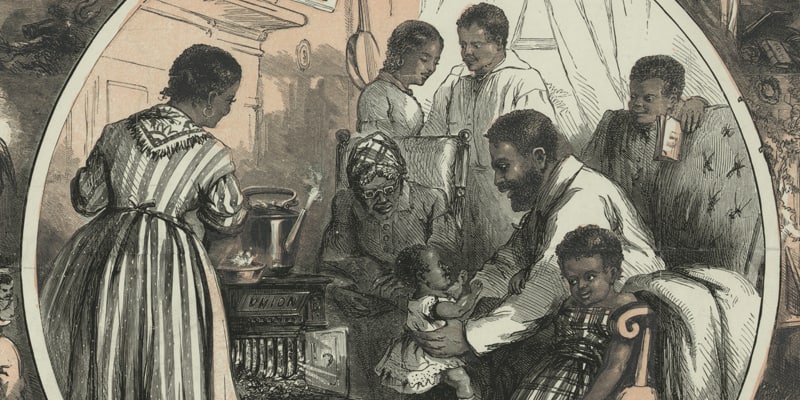
Juneteenth engraving by Thomas Nast. ca. 1865, via American Civil War Museum.

Just thinking about the degree to which the Juneteenth celebration might be, now that it's a national holiday, a commemoration of what historian Eric Foner called the Second Founding, following on the Civil War, in which the Republic of 1787 was replaced by the Democracy of Abraham Lincoln's intentions as expressed in the Gettysburg Address (that government of the people, by the people, and for the people shall not perish) and as spelled out in the explicit constitutional changes of the 13th, 14th, 15th, 16th, 17th, and 19th Amendments (respectively abolishing chattel slavery in 1865, defining citizenship and offering equal protection under the law to all citizens in 1866. guaranteeing voting rights regardless of race in 1870, establishing the income tax in 1913, establishing direct election of senators in 1913, and guaranteeing the right to vote regardless of sex in 1920).

This really is what we're arguing about when conservatives say that the United States was not founded as a democracy but as a "constitutional republic"—feel perfectly free to say that, guys, and fight over the finer details, but the point is that it's not that any more: it was that, and we fixed it, to some extent, in the course of eradicating slavery, by changing the Constitution. Now, it's something different, and more democratic, as a consequence of each of those changes, though much work remains to be done.

Nathan Newman is making practically the same statement, with a slightly different terminology (to him the signing of the Articles of Confederation created the Second Republic and the 1787 Constitution the Third) and a reduced list of Amendments:

Juneteenth, celebrating the final word of the end of the Slave Constitution reaching the last slaves in Texas, marks the foundation of the Fourth Republic of our Nation, the one where the 13th, 14th, and 15th Amendments fundamentally reshaped the nation into a new constitutional order. As the southern states were readmitted only under conditions set by the US Congress, the new Republic’s principle was one of firm subordination of state authority to national power. Enforcement Acts would send troops to the South to enforce new civil rights laws, creating voting rights for all (male) Americans, a Freedmen’s Bureau would establish federally-run schools in the South, and other laws would ban segregation and build public works throughout the nation, most notably an Intercontinental Railroad. This is the nation most liberals recognize as our modern nation's core source and model.

I like how he emphasizes the Whiggishness of the new country, its commitment to an enormously more powerful central government engaged in infrastructure and education and the promotion of equity. The 20th-century amendments in my list further the same project—the income tax following up on an idea first implemented by the Lincoln Administration in the Revenue Act of 1861 (which also levied a federal tax on land, an idea to which I and my friends Professors Piketty, Saez, Zucman, and Warren remain deeply attached) to allow the federal government to raise a lot of money for its plans on a progressive basis, the direct election of senators remedying a ridiculously old-fashioned method of nominating them, and women suffrage repairing a hole that was becoming a scandal.

Meanwhile, the Republican Party of Texas has chosen the Juneteenth holiday to release its 2022 "platform":

You can't make it much clearer than that. Oh, wait, yes you can:

  • If approved, the new party platform would include declaring homosexuality “an abnormal lifestyle choice," repealing the 16th Amendment that created the federal income tax, and mandating that Texas students "learn about the humanity of the preborn child,” in part by forcing students to listen to ultrasounds of gestating fetuses.

They're basically asking to reverse the results of the Civil War.

Wednesday, January 5, 2022

Overly Civil War

A post from Steve M ("A Civil War With No Gunfire") argues, I think correctly, that the real coup Republicans are putting together for next time isn't going to be an assault in the style of 6 January but the completion of the attempts to rig the voting system conservatives have been working on since forever, I guess especially since Bush v. Gore, by writing Republican dominance into the design of state and federal legislative districts instead of depending on the whims of voters, and taking away what power voters still have in appointing the electors in presidential elections and delivering it to the state legislatures to overturn the ones they don't like (unilaterally deciding they're "fraudulent").

It struck me that the base, used to bloodthirsty Trumpiness and really gearing up for a proper war, might not be too roused by this strategy—as I was noting the other day focus on dubious cases of election fraud seems to bring down Republican turnout—and Steve's rhythm brought me a visit from the Muse, with apologies to Irving Berlin and Jerome Kern, to the tune of:


A civil war with no gunfire
A crashing bore, a no-fun fire
We should be dressed like seventeen-sev'nty-sixers
Instead we're led by dozens of K Street fixers

A civil war with no cannon
Is just a snore for Steve Bannon
If you don't spill some unpatriotic gore
What is it even for?
Overly civil war

A civil war with no bleeding
Is not the score that Trump's needing
You may have found an argument that convinces
But not the ones from wherever Erik Prince is

A civil war with no bullets
Is not for guys who wear mullets
If you don't spill some unpatriotic gore
What is it even for?
Overly civil war


Wednesday, July 14, 2021

For the Record: Crenshaw Is a Wanker


Image via howtofightantisemitism, 2018.

I've been superbusy. Hope material in this thread isn't too familiar:

Because a lot of people forget that the Democrats persisted in the North, especially in big cities like New York and Boston, where they already stood not for slavery but for labor, and the vulgar immigrants from Ireland and Germany.

Monday, January 13, 2020

Healing a Divided Nation

Luo Kisii people of Nyanza, Kenya, photo by E.E. Evans-Pritchard, 1936, Pitt Rivers Museum, Oxford.


Well, I suppose maybe it means thinking about the future, and your place in it. Are you going to dwell in the easy randomness of Downtown, its walkable maze of streets where you disappear whenever you want, or the formal determination of Uptown, where you take taxis and elevators in and out of, and up and down in, the hierarchy? Brooks opted for seriousness in that sense, and read Burke's Reflections on the Late Revolution in France instead of Huckleberry Finn and Women in Love.

But there is something we're worrying about all the same, isn't there? In the concept of a "divided nation"? Isn't this about something or other important? Whether we're afraid of the hot civil war Republicans keep threatening us with if Trump isn't reelected or that "epistemic crisis" David Roberts/Vox was lamenting in November, on the divide between those who work within what they hope is a transpartisan morality and those whose morality is "tribal":

Friday, November 24, 2017

Fundamental and astounding

Presidential nominee, 1860, via The History Place.
David Brooks has finally come up with an idea for that new national narrative he's been talking about, I think, and it's a doozy ("America: The Redeemer Nation"), custom made for Thanksgiving: just as he's suggested in the past that Jews ought to celebrate Shavuot on Passover instead of Passover, so on Thanksgiving he's celebrating Lincoln's Second Inaugural address.

The story of America, then, can be interpreted as a series of redemptions, of injury, suffering and healing fresh starts. Look at the mottos on our Great Seal: “A New Order for the Ages” and “Out of Many, One.” In the 18th century divisions between the colonists were partially healed. In the 19th century divisions between the free and enslaved were partially healed. In the 20th, America partially healed the divisions between democracy and totalitarianism. In the 21st, we have healing fresh starts still to come.
The great sermon of redemption and reconciliation is Lincoln’s Second Inaugural.
That's such a bizarre picture of the Revolution, in the first place, "divisions between the colonists", as if the British government had nothing to do with it. It's true that some 15%-20% of the Americans nominally supported the Crown, though they never came out to fight in anywhere near the numbers the British hoped they would.

Wednesday, November 1, 2017

Who Does General Kelly Resemble?

Unveiling of the Robert E. Lee statue in Richmond, Virginia, 28 May 1890, via Danish Wikipedia.

After General Kelly's somewhat thoughtless remarks about the Civil War to Laura Ingraham on the TV—
“I would tell you that Robert E. Lee was an honorable man,” Kelly told Ingraham. “He was a man that gave up his country to fight for his state, which 150 years ago was more important than country. It was always loyalty to state first back in those days. Now it’s different today. But the lack of an ability to compromise led to the Civil War, and men and women of good faith on both sides made their stand where their conscience had them make their stand.”
—everybody's dumping on old Kelly.

(I should mention that no, it was not always loyalty to state. The Union Army called itself the Union Army because it believed that the Union trumped the individual state, and the language of the Constitution, including the oath sworn by guys like General Lee, backed that up.)

Not just exposing his deep and startling ignorance of history as Ta-Nehisi Coates did  (in tweets repeated at TPM). No, people are accusing Kelly of being, disappointingly, no different from Trump himself. Not to mention refusing to apologize for his public false statements about Rep. Frederica Wilson. Chris Cillizza, of all people, the most slack-minded, smirky politics fashionista in town, accuses Kelly of being Trump's "Mini Me":
increasingly, it seems as though Trump is drawn to Kelly for another reason: Because they see the world similarly. Trump likes people who affirm his views and who are willing to battle political correctness and the media at every turn. Kelly appears to be ready and willing to take up arms in those fights.
So in the name of simple fairness, I'd like to clarify that General Kelly's thinking is not like Donald Trump at all. It's more like David F. Brooks.

Saturday, August 26, 2017

Weekend long read: Party of Lincoln

Image via C.K. Coleman.
I've  been paying a ridiculous amount of attention lately to rightwing academic fraud Dinesh D'Souza and his new booklike object, The Big Lie: Exposing the Nazi Roots of the American Left, an extended argument that the party of Nancy Pelosi, Tom Perez, and Keith Ellison is objectively pro-slavery, since it was founded 190 years ago by slaveholders, and therefore Nazi, because Hitler's Nationalsozialistische Deutsche Arbeiterpartei was directly inspired by those leftists John C. Calhoun, James Buchanan, Jefferson Davis, and the Ku Klux Klan and Senator Theodore Bilbo, and Al Smith and Franklin Delano Roosevelt too, who were all essentially the same person, as you can tell by the presence of the word "sozialistisch" in Hitler's party name. And the progressive birth control advocate Margaret Sanger is in there because tying the tubes of intellectually disabled women without asking them for permission, which she thought was a good idea, seems wrong to us, and gassing Jews seems wrong to most of us as well, so that proves gassing Jews is a progressive program*, though only in a Democratic, Woodrow Wilson sense of "progressive", not a Republican, Theodore Roosevelt** sense.

I know it's so stupid it's not worth thinking about in serious times like these, but the thing is D'Souza's thesis is a reductio of a kind of thinking that can be found all over the place, for example in a piece in yesterday's Washington Post by somebody who seems like the opposite of D'Souza in almost every respect, the calm and dignified, indisputably honorable and honest, eminently moderate, compromise-loving, Episcopal priest and former Republican Senator from Missouri John Danforth, an unwavering Trump opponent (in theory at least; I can't find him publicly mentioning Trump's name between December 2015, when he found Trump revolting, and now, when he still does), who writes:

Tuesday, May 2, 2017

For the record

Jackson in 1844 or 1845, via Wikimedia Commons. He'd have been 93 at the outset of the Civil War.

I want to add, to yesterday's poem, that Trump's rewrite of history isn't just silly ignorance. Who introduced Trump to the history of the Jackson presidency, as Peter Baker reminds us in today's Times, is Stephen Bannon, and as Baker fails to remind us, it's a pretty sinister, white supremacist story. Trump himself doesn't tell it right, so, in brief:


Monday, May 1, 2017

Andrew Jackson has done an amazing job that is being recognized more and more

Grave of Rachel Jackson (1767-1828) at The Hermitage near Nashville. It's not surprising that President Jackson should have visited it every day (probably, like Trump, only when he was in Tennessee), since it was in his back yard. He himself was also buried there, after his death in 1845, so that people nowadays often think of it as his grave too. Photograph via Trip Advisor.

Had Andrew Jackson Been a Little Later
by Donald J. Trump

Friday, June 26, 2015

Dukes of Moral Hazard

On a bright day you can hardly see those stars and bars on the roof, and it's always sunny in Hazzardelphia.  But why can't you call it, say, the General Beauregard?

David Brooks writes ("The Robert E. Lee Problem", June 26 2015):
The debate about what I'll call the Charleston Bible study shooting, because even at this date if you assume it has something to do with race that could only hurt people's feelings, and I have this reputation for courtesy I have to keep up, has oddly transformed itself into a debate about the former Confederate States of America and their battle flag, which is not a trivial matter, because a flag is made of woven material and racism is a part of what it is woven from, though whether weft or warp is beyond my expertise.

Tuesday, July 2, 2013

Gettysburg addressed

It's the 150th anniversary of the Battle of Gettysburg today, and by one of those amazing coincidences a book about the battle just dropped into David Brooks's Kindle. It's got tons of quotes from letters by the soldiers, so a column ought to virtually write itself.

Unfortunately Allen Guelzo's new Gettysburg: The Last Invasion turns out to be kind of negative. Some of the things it has to say about the soldiers are really not very nice. Much better to turn to James McPherson's For Cause and Comrades: Why Men Fought in the Civil War, from 1998, which explains that the warriors were motivated by
“patriotism, ideology, concepts of duty, honor, manhood and community.” The soldiers were intensely political. Newspapers were desperately sought after in camp. Between battles, several regiments held formal debates on subjects like the constitutional issues raised by the war. “Ideological motifs almost leap from many pages of these documents,” McPherson reports. “It is government against anarchy, law against disorder,” a Philadelphia printer wrote, explaining his desire to fight. [jump]
Image from Petey and Petunia.