Showing posts with label Cartesian political science. Show all posts

Friday, December 10, 2021

Skowronek Season


xkcd

Ah, it's Skowronek Season already! Coming unusually early this term, when pundits gather to ask themselves what kind of relationship the current presidency is going to have with the longer-term current "regime", or complex of ideologies and interests out of which politics of a whole period are made, according to the framework put together by political scientist Stephen Skowronek in the 1990s: will it be a presidency of reconstruction, effectively opening a new regime, like those of Jefferson, Jackson, Lincoln, Franklin Roosevelt, and Ronald Reagan?  Or of articulation, clarifying and maintaining the ideological goals of a reconstructive predecessor, like Madison, I suppose, Van Buren, Grant, Truman, G.H.W. Bush? Or of preemption, struggling for change against a resilient regime that remains more powerful than they are, like the Democratic presidents, A. Johnson, Cleveland, and Wilson, of the Lincolnian regime (Skowronek, I'm told by a critic of the theory, doesn't have a lot to say for this category), or of disjunction, over a regime in collapse (Quincy Adams, Buchanan, Hoover, Carter)? 

So Corey Robin, who came out strong in 2019 for the theory that the Trump presidency was a disjunctive one, is already out with a judgment on Trump's successor on the Times op-ed page ("Why the Biden Presidency Feels Like Such a Disappointment"), which is, well, that it's disappointing, or "feels" disappointing, which may come down to the same thing. Because while Robin doesn't say what kind of presidency Biden's is going to be, he's pretty sure it won't be reconstructive, and a lot of people, including himself, had hoped it might be.

In the first place, because the Trump presidency had been so extremely disjunctive, like nothing the nation had ever seen before, with a Congress unable to accomplish anything but preserve itself (tax cuts and deregulation to hold onto its donors, and judicial nominations, and judicial nominations to prolong such power as it was able to retain) and a president unable to accomplish anything at all, not even build his stupid wall or withdraw from Afghanistan, let alone his promised revolutions in infrastructure and health care. And then of course with the arrival of the Covid pandemic a situation of actual collapse from which it took the Democrats in the House of Representatives (and the Federal Reserve) to begin rescuing the nation, with the extraordinary "stimulus" bills of 2020. 

And then after the disappointment of Robin's own hopes for a Sandernista revolution, the disappointingly "moderate" Biden roused new hopes by beginning seemingly to transform himself with an idea of reconstructionism, to be trying to picture himself in the shoes of FDR or at least Obama with his "big fucking deal":

The combination of the Covid economy, with its shocking inequalities and market failures, and a summer of fire and flood seemed to authorize a left-leaning politics of permanent cash supports to workers and families, increased taxes on the rich to fund radical expansions of health care, elder care and child care, and comprehensive investments in green energy and infrastructure, with high-paying union jobs.

Most important, the package cohered. Instead of a laundry list of gripes and grievances, it featured the consistent items of an alternative ideology and ascendant set of social interests. It promised to replace a sclerotic order that threatens to bury us all with a new order of common life. 

Which, of course, the Congress has indeed begun to pass, for $3 trillion so far in the American Rescue and BIF packages, with another trillion or two to come in the BBB, in spite of the Democrats' precarious hold on the legislature (compared with Roosevelt's massive majorities from the 1932 election).

But it's all ashes in Robin's mouth because of what Biden has not accomplished after 11 whole months in office—the end of the filibuster, the curbing of the gerrrymander, statehood for Puerto Rico and DC, essential reform on voting rights and election procedures, and "labor law reforms, enabling workers to form unions," because of the factors we all know about.

I really think this is a mistake, and not only because it's not being given enough time. I'm saying it because, if Skowronek's theory really is any kind of theory, it positively predicts that these other elements will come, sooner or later, because the structural conditions for a reconstructive presidency are met, and the Biden plans (as Robin describes them, including the things Biden hasn't done yet) responds to it so neatly. Unless there is some completely different kind of transformation in the offing, like the end of democracy altogether in Bannonite fascism, which Stephen Bannon, and Erik Prince, and the other rich-boy fascist cosplayers, don't have the skills or energy to produce (Stone and Manafort did). 

The other possibility we're looking at right now, the Republican takeover of the presidential election system through GOP legislatures in blue or blueing states (Michigan, Wisconsin, Arizona, North Carolina, Georgia, Texas) is a preemptive attempt to prolong the agony, not a decisive reconstruction, in my opinion. It'll be awful, and could take a very long time, but it won't overturn whatever gets passed in the Biden agenda and it won't achieve anything permanent. The "new order of common life" Robin sees in the BBB will survive—just barely, perhaps, the way the Affordable Care Act did in the first round—for the time when the reconstruction proper begins.

(1) Reconstructive presidencies are most likely to follow moments of extreme crisis, like the secession of the Confederate states in 1860 or the Great Depression, the worst crises the Union has ever endured (Pearl Harbor was very scary, but the government in late 1941 was very resilient. The Reaganaut regime has been in effective collapse for a long time, since at least 2005 or 2006, when it became clear what disasters the two Bush wars were, followed by Hurricane Katrina and then by the 2008 financial collapse; the Obama administration decided to rescue it without attempting a reconstruction, even as they pushed through very important legislation on healthcare and banking, only to see their successor plunge the country back into crisis with unsustainable deficits, an unplanned withdrawal from foreign engagements, and finally a lethal plague.

(2) Robin is certainly right to say that 

What each of these presidents had at their back was an independent social movement. Behind Lincoln marched the largest democratic mass movement for abolition in modern history. Alongside F.D.R. stood the unions. Each of these movements had their own institutions

—but Biden has two of those: an extraordinarily rejuvenated labor movement that has taken off in the middle of the pandemic to win unprecedented wage gains for workers, and an extraordinarily successful group of Black activists, mostly female, who were behind Biden's victory in the South Carolina primary (while Robin was still mooning over the Nevada caucuses) and the conquest of Georgia in the general election.

(3) The Biden administration has saved the economy in a way that's much clearer to the public than the way the Obama administration did in 2009, as Professor Newman says:

In fact, the US is the only leading economy where real household income - which takes into accounts inflation- as well as overall GDP, are higher now than before the pandemic hit. Every country has struggled with pandemic recovery challenges, from reopening schools to dealing with supply chain disruptions, but strong government action meant the U.S. has recovered far better than other countries.

Something huge is going to happen, if there's anything to Skowronek's theory, and it's just as likely to be the nice thing as the dreadful thing—indeed, at least a bit more likely, to the extent that the dreadful thing hasn't ever happened before and the nice thing has, quite a lot, considering.

Cross-posted at No More Mister Nice Blog.

Thursday, December 9, 2021

Slave of the Passions


David Brooks in his longform gig at the Atlantic going on about how No True Conservative can be a Republican any more ("What Happened to American Conservatism?") finds himself in a funny predicament, contemplating Hume's moral philosophy:

Your emotions can be trusted, the conservative believes, when they are cultivated rightly. “Reason is, and ought only to be the slave of the passions,” David Hume wrote in his Treatise of Human Nature. “The feelings on which people act are often superior to the arguments they employ,” the late neoconservative scholar James Q. Wilson wrote in The Moral Sense.

The key phrase, of course, is cultivated rightly. A person who lived in a state of nature would be an unrecognizable creature, scarcely fit for life in society, locked up within and slave to his own unruly desires. The only way to govern such an unformed creature would be through a prison state. If a person has not been trained by a community to tame his passions from within, then the state would have to continuously control him from without.

The "key phrase, of course" is the one Brooks just made up? Because you must be a slave to the passions (by which Hume means nothing more than "emotions", or "sentiments"), but only the correct ones, otherwise you might be a slave to the passions, and that would be terrible?

Thursday, March 26, 2020

Cybernetic Democracy


An enchanting interview on NPR with Mayor Betsy Price of Fort Worth on the Covid-19 response in Texas carries the headline "Coronavirus Guidance Across Texas Is Not Consistent" at their website,  but that's really not accurate. It's pretty consistent, just at odds with governor Greg Abbott and of course the suicide volunteer lieutenant governor Dan Patrick; Abbott's been resisting calls for him to issue a statewide stay-at-home order, and the mayors and executives of the state's largest cities and counties have reacted by creating the situation that Abbot's order would have created, without his assistance.

That is, they've gotten together (by Zoom, presumably, they're practicing social distancing) and coordinated the issuing of orders of their own, covering 70% of the Texas population, and the other counties are coming on board one at a time, so it's going to be as if Abbott had issued a timely order. And indeed Abbott is now suggesting he might do it after all:

Thursday, February 6, 2020

The Third Dimension

White mochi with macha filling, via Uncut Recipes.

So Jordan was wondering over in the comments how David Brooks might have reacted to the Clinton impeachment 20 years ago, and I found something kind of—unsurprising might be the right word, from David Nyhan writing for the Boston Globe in January 1999, who watched a Brooks appearance on PBS looking back at the failure of the Senate trial, and, spoiler, no, he didn't talk about how Gingrich's House ought to have been working on infrastructure bills instead:
"This is a Great Lost Cause," he enthused of the Republican drive to snuff out the Clinton presidency. "We fought for truth, for justice," he said. That notion was novel to me. This whole thing has looked like a down-and-dirty political ambush from the word go, to me and to most Americans. I could never buy the William Bennett Moral Crusade; I always suspected that was a book-tour con.
But Brooks found what he gamely phrased "a kernel of romance" for Republicans in this yearlong dive into the cesspool of semen-stained dresses, cigars in the wrong places, sneaky tapes of a ditzy young intern by a repulsive Republican operative (can anyone defend the taxpayers still paying $90,000 a year to Linda Tripp for her no-show Pentagon job?), and the greasy pawing-over of tapes, transcripts, appointment logs, Secret Service records, and other detritus of the 60,000-page House impeachment probe.
Brooks looked ahead to the Republican National Convention of 2000 and through the mist of the future, saw Henry Hyde, chairman of the House Judiciary Committee, being summoned to the podium to accept the plaudits of a grateful party, with the crowd roaring for Hyde and his fellow impeachers: "They stood for principles against the polls."
It strikes me that there's more to this than simple hypocrisy, a simple double standard for Republicans vs. Democrats; or maybe I should say it's a motivated double standard.

Tuesday, October 17, 2017

Transhumans and Cishumans

Image via transumanity.net.

It's transhuman activist David F. Brooks with a new opus in his beloved there-are-two-kinds-of-people genre, "Upswingers and Downswingers", which looks on its face as if it might be drawing its inspiration from boxing, or maybe wife-swapping—Upswingers are couples who like to swap with couples of higher social status, while Downswingers descend to their inferiors, and in politics it's sort of similar:

Both right and left are dividing into upswinger and downswinger camps. Among Republicans the upswingers embrace capitalist dynamism, global engagement and the open movement of people and ideas. The downswingers embrace ethnic and national cohesion and closed borders.
On the left it’s between those who believe the only realistic path is to reform existing structures and those who think they are so broken we need to start over.
But no, it turns out that it's based on a kind of typo inside Brooks's memory, projected onto the science fiction writer and futurology professor born as F.M. Esfandiary (1930-2000), and his 1973 Up-Wingers: A Futurist Manifesto, which

Wednesday, September 13, 2017

The Fire Next Time. II

The important part about the David Brooks flood column that commentators seem to have missed is asking, if Noah had such terrible leadership qualities—
What does Noah do now? Once again, Noah is silent. He does nothing. He sits in the ark for another seven days twiddling his thumbs. He is waiting for God’s permission to disembark.
—why did old JHWH pick him for the gig in the first place? I'm sure there must have been some much more suitable candidate.

Look at ingenious Greeks Deucalion and Pyrrha, who figured out how to broaden the gene pool for repopulating the earth after their flood (the Titaness Themis gave them the oracular advice to "throw your mother's bones behind you", so they threw stones—the bones of Mother Earth—over their shoulders and these turned into new people). Did Noah think of anything like that?

Deucalion and Pyrrha casting stones, from relief in the Labirint d'Horta, Barcelona, via Encyclopedia Brittanica.

Friday, November 18, 2016

Don't miniaturize me, bro!

Image by Gawker Media, February 2013.
Verbatim David Brooks, "The Danger of a Dominant Identity", New York Times, November 17 2016:
But it’s not only racists who reduce people to a single identity. These days it’s the anti-racists, too. To raise money and mobilize people, advocates play up ethnic categories to an extreme degree.
I think we've reached peak bothsiderism, where the pro-racist and the anti-racist teams are fundamentally the same, and the implication is that a decent person would be neutral with respect to racism, dispassionate and not involved in anything so crass as raising money.

There's a very useful idea poking around the column, or a useful set of ideas, around what you might call the concept of Social Identity Complexity (he doesn't tell us what thinkers he's getting it from, and I'm not going to try to find out), or the obvious fact (it's obvious, but too many social scientists and pandits act as if it wasn't true) that everybody has more than one identity, in realms of gender, class, nationality, ethnicity, language, religion, music preference, brand loyalty, and so on, and more than one identity inside certain particular realms, including language and ethnicity (evidence is that the majority of the world's population is bilingual or multilingual, something that might surprise our fervently monolingual typical USian). But David Brooks, one of the worst offenders in the past months in the construction of a monolithic "white working class" (as opposed to the more up-to-date concept of an intersection among racial, class, and gender identities), is not the man to guide us through it.

Most comical bad writing in the column:
Anti-Semites define Jewishness in a certain crude miniaturizing way. Racists define both blackness and whiteness in just that manner.
Honey, I shrunk the Jews! Or, if you prefer, Don't miniaturize me, bro! There's something exceptionally strange going on in there, though, in the disjunction between anti-Semites and racists (anti-Semitism isn't a form of racism?), and the suggestion that "racists" do to the black and white alike what anti-Semites do only to the Jew and not to the Gentile. What it's pointing at, I'm pretty sure, is the invisible white guy, who happens to be Jewish and maybe not very comfortable with it, in the mirror where David Brooks shaves, and the concept of anti-racists mentioned above. What Brooks is objecting to overall is a kind of conspiracy to make him, Brooks, feel like a white man himself.

Well, he is a white man, of course, but that's such an indelicate, demeaning way of putting it, making it sound as if he's somehow complicit in racism himself, which is absurd! He's not really anything special, he's just regular, as my WASP mom used to put it before she got somewhat woke. It's so hurtful when you insist on putting him into that basket, when you tell him he has a race of his own. It's different for all those masses populating his columns, they're used to it, and they don't have his unique refinement.

That's how the racists and the anti-racists are alike, in making David Brooks feel as if he's in their quarrel instead of serenely above it. How dare they!

Driftglass caught the main point too. It's hard to think of a good reason for reading beyond that.

Wednesday, November 16, 2016

I believe in closed, Alfie

Bound fabric. Hand-dyed "Dark Shadows" by Blackberry Primitives, via Etsy.
I shouldn't totally give up on last Friday's Brooks, outlining his post-Trump plans for that third party, which don't seem to be that different from the pre-Trump plans, but there's some very funky argumentation, starting from a pious hopefulness that the coming cataclysm won't be the end of humanity:
If [Trump]’s left to bloviate while others are left to run the country and push through infrastructure plans, maybe things won’t be disastrous. The job for the rest of us is to rebind the fabric of society, community by community...
What makes him think that Paul Ryan's House and Mitch McConnell's Senate are interested in pushing through infrastructure plans is anybody's guess. Ryan's already on record as saying they spent quite enough on infrastructure last year, thanks very much:

Tuesday, November 8, 2016

Vote!

I'm winning with women! Apparently. And women are winning with me! Image via Hotline Bling.
Shorter David Brooks, "Let's Not Do This Again", New York Times, November 8 2016:
This horrible election has shown that our country is coming violently apart, much more deeply divided than we realized, on class and ethnic lines that have come to match the partisan divide. I've always opposed the idea of a third major party, mainly because of the structural barriers it faces, but now I think a third party confidently opposed to populism is necessary, because the only way to unify our country is if we divide it three ways instead of two.
I might get back to this column later, but it's pretty silly. I have to vote! And do some stuff!

Wednesday, November 2, 2016

Warring monologues

Martin Buber, via Wikipedia.
Yesterday was philosophy day in Brooksville! "Read Buber, Not the Polls!"
There has been so much bad communication over the past year: people talking in warring monologues past each other, ignoring the facts and using lazy stereotypes like “elites” and “Trumpeans” to reduce complex individuals into simplistic categories. Meanwhile, our main candidates are poor connectors. We’ve got the self-enclosed narcissism of Donald Trump and, to a lesser degree, the mistrustful defensiveness of Hillary Clinton’s campaign.
Using a lazy stereotype like "mistrustful defensiveness" to reduce Hillary Clinton to a simplistic category.
As an antidote for all this, I’ve been reading the work of Martin Buber, the early 20th century Jewish theologian who dedicated his career to understanding deep intimacy. Buber is famous for the distinction between I-It relationships and I-Thou relationships.
Question to Radio Yerevan: Did Martin Buber, the early 20th-century theologian, dedicate his career to understanding deep intimacy?

Tuesday, October 4, 2016

The Lovely Society

Update: Thanks for the shout-out, Drifty! (And to anybody here who hasn't already been there, go there.)

Sweet parfaits of emotions, photo via Woman's Day.
Shorter David Brooks, "Trump, Taxes and Citizenship", New York Times, October 4 2016:
See, the reason Trump doesn't pay any taxes is that he thinks of himself as a taxpayer rather than a citizen. This is just logical. And in a way isn't that true of all of us? We could be living in a Lovely Society, in a web of giving and getting and trust and sweet, sweet, sweet inspiration, and instead we're suspicious, defensive, and competitive, alone at 3 A.M. tweeting out at our enemies. Nous sommes tous Trump!
Just a few things.

1. There's a long paragraph quoted from David Foster Wallace:

Tuesday, September 27, 2016

Give me that old-time conservatism, it's good enough for me

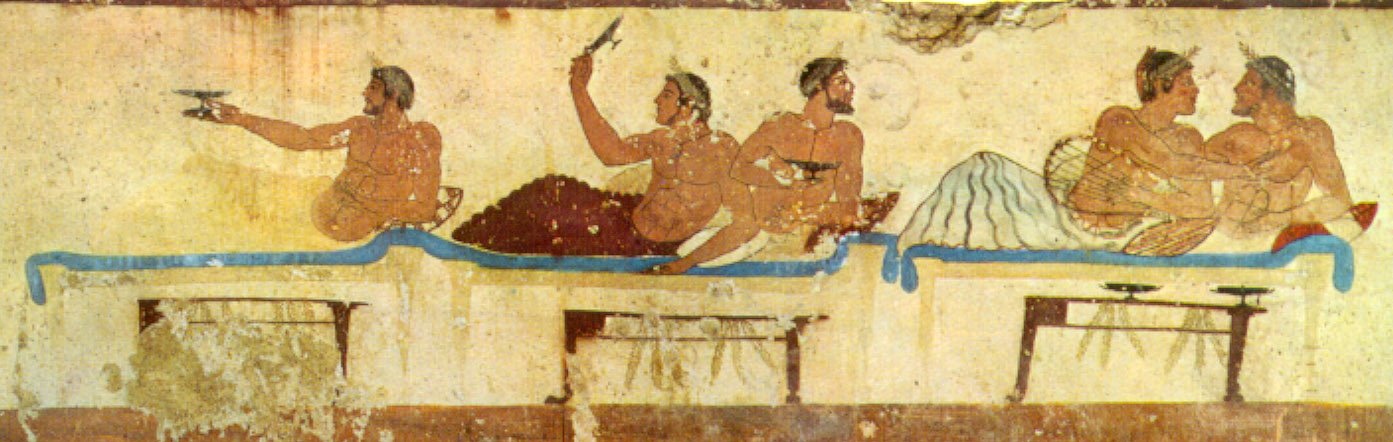
Typical symposium, from the Diver's Tomb at Paestum, Campania, ca. 475 B.C.E., or about 60 years before the poet Agathon threw the unforgettable party, after his victory in the playwrights' competition in the Dionysia of 416, that Plato (who wasn't there) dramatized in his great Symposium three or so decades afterwards. Via Wikipedia. You guys on the right get a room, for Apollo's sake!
Shorter David Brooks, "The Age of Reaction", September 27 2016:
The real problem is the crappy conservatives we have nowadays. Conservatives in my time used to be people you could look up to, with positive ideas, moderate but optimistic religiosity like Dr. Martin Luther King, Jr., and a humanistic appreciation for progress, and now they're all nothing but a bunch of reactionaries. These kids make me sick.
So he's a kind of meta-reactionary himself, yearning to go back to when the conservatives were the right, clubbable sort. That's after castigating Hillary Clinton on Friday for being mired in the tired ideas of the 20th century.

Obviously I'm psyched about the debate, but everybody's writing great stuff about it, and I was really busy all day, and here's Brooks, and this strange doom of mine to deal with him week after week. There's a couple of laughs coming, in any event.

It's book report day at Brooks's shop. He must have had to file early yesterday afternoon so he could get over to the PBS studio for the Great Debate, where he was needed to deliver such deathless insights as

Monday, September 26, 2016

Twentieth-Century Box

One of Hillary Clinton's old-fashioned, 20th-century celebrity endorsers, like Streisand and Cher. Photo by Ramona Rosales via Billboard.

Oops, I forgot all about David Brooks and his Friday column ("The Clinton Calendar")! And now there are fine posts out by Steve and Driftglass and Bethesda 1971. And here's Dr. Krugman, as usual not referring to Brooks by name but as "pundits":

Here’s what happens every election cycle: pundits demand that politicians offer the country new ideas. Then, if and when a candidate actually does propose innovative policies, the news media pays little attention, chasing scandals or, all too often, fake scandals instead. Remember the extensive coverage last month, when Hillary Clinton laid out an ambitious mental health agenda? Neither do I.
For that matter, even the demand for new ideas is highly questionable, since there are plenty of good old ideas that haven’t been put into effect. Most advanced countries implemented some form of guaranteed health coverage decades if not generations ago. Does this mean that we should dismiss Obamacare as no big deal, since it’s just implementing a tired old agenda? The 20 million Americans who gained health coverage would beg to differ.
That's a direct response to Brooks's complaint on Friday that Clinton had failed to join us here in the 21st century:

Friday, September 9, 2016

Molten cores and racial wedgies

Image via DNews.
World-famous futurologist David Brooks has big political plans for you, people ("Time for a Realignment"):

There’s a good chance many of you will be switching political parties over the next 15 years. You may be a corporate executive who’s voted rock-solid Republican for decades, but you may be a consistent Democrat by 2024. You may be an African-American community activist in Cleveland, but don’t be surprised if you someday call the Republican Party home.
It's another stab at that "realignment" column he tried writing a couple of months ago, where everything is going to change or has already changed because of Trump or in spite of him, as the case may be, the details are still pretty fluid, and we will end up with a new party system representing the open vs. the closed, in the picture you might get by jumbling recent research by fascist Charles Murray and liberal Robert Putnam and David Brooks's own journey into the heart of whiteness of earlier this year, where, as you'll recall, he crossed from the bourgeois strata across the chasms of segmentation into the pain to interview a couple of high school principals and factory owners in Pittsburgh, and possibly some other folks in some other towns as yet not revealed:

Tuesday, July 26, 2016

When you come to a fork in the road, take the middle

Pola Negri in Mal St. Clair's A Woman of the World (1925). Image via Fritzi, who has her own review.
David Brooks, still incredibly unfired ("Hillary, This Is Why Democrats Are Still Struggling", July 26 2016), may think the candidate is "squirrelly" and "willing to blatantly lie to preserve her career", but that doesn't mean he wouldn't offer her some heartfelt advice:

PHILADELPHIA — Dear Hillary,
Donald Trump has presented you with an amazing opportunity to become a world historical figure! If you crush him in this election, you could create a new Democratic majority and reduce the G.O.P. to an ever-declining rump of ethnic nationalism. On the other hand, if you fail to beat Trump, you will go down as America’s most hapless political loser and be vilified forever for enabling an era of American Putinism.
No pressure! Have fun in Philadelphia!
(There's the 145th career use of "amazing/amazingly".)

No, I don't see any concern trolls. Do you see a concern troll? Really? You mean you think Brooks doesn't sincerely want Clinton to create a new Democratic majority and reduce the GOP to an ever-declining rump of etc.? You cynic you.

Saturday, July 9, 2016

Some methodological errors in the thinking of David F. Brooks

John Agar in Nathan H. Juran's The Brain from Planet Arous (1957). Via Chandler Swain Reviews.

David F. Brooks is still writing that column about how somebody needs to give Western society a makeover, because it's getting awfully tatty and mean. As a matter of fact the column is getting pretty tatty too.

This time it is called "The Power of Altruism", under the influence of the French biologist and Vajrayana monk Matthieu Ricard, whose Altruism: The Power of Compassion to Change Yourself and the World came out in English just a year ago, horrible self-help book subtitle and all (the French title, Plaidoyer pour l'altruisme: La force de la bienveillance, sounds a lot more dignified, presented as a lawyer's brief for the defense, and using the noble "benevolence" instead of the sickly "compassion", and omitting the self-help how-to coda).

I am totally on board with the idea that it would be a good thing for all of us to spread around a little more of that "love and kindness" as my girl Hillary Clinton likes to call it, if we can, and loath to cast any doubts on the soundness of Ricard, who is a trusted French translator for the Dalai Lama, but as far as Brooks goes, you know, odds are always that he's doing it wrong, whatever it may be, and this train of thought as he represents it is no exception. Indeed, the new piece presents an especially clear opportunity for explaining Brooks's inability to understand what societies are, how they work, and what could be done to improve them, starting with his bizarre first sentence:

Tuesday, July 5, 2016

The Lemurian Candidate

Angela Lansbury in The Manchurian Candidate (John Frankenheimer, 1962). Image via Nitrate Diva.


It's world-famous political scientist David Brooks, here with his hot takes on how the political world is currently working, or failing to work ("Choosing Leaders: Clueless or Crazy", July 5 2016):

These days, if you want to elect a leader, you generally have two choices: a sensible, establishment figure who is completely out of touch, or a populist outsider who is incompetent, crazy or both.
I'm inevitably asking myself how that applies to the 2015 contests in Greece, Nigeria, Israel, UK, Argentina, Canada, Burkina Faso, Spain, or Myanmar,  or this year's elections in Peru, Serbia, the Philippines, and Australia. Which figure in that schema is Daw Aung San Suu Kyi, or Justin Trudeau? Or Muhammadu Buhari? Keiko Fujimori and Pedro Pablo Kuczynski? Isaac Herzog and Ed Miliband might count as sensible, establishment figures who are completely out of touch, but their opponents were the less-than-populist hardly-outsiders Binyamin Netanyahu and David Cameron respectively.

I can see complaints that the new Filipino president Rodrigo Duterte may qualify as populist and crazy, though hardly an outsider or incompetent, given that he served as mayor of Davao City, the country's third most populous city, for 23 of the last 28 years, where he encouraged a literal war on drugs conducted by extrajudicial death squads, and remarkable police brutality against protesters, but also was a strong supporter of LGBTQ rights. Last September he personally showed up at a local bar where a foreign tourist was violating the anti-smoking ordinance and forced the offender to swallow his cigarette butt. As president, he has offered a Trumpian pivot, promising to be "prim and proper... almost, I would become holy." He is in some ways what Trump wishes he was, a truly tough guy, competent and psychopathic at the same time, compelling and deeply appalling.

Other than that, I'm really not seeing it.  The sensible-but-clueless will always be with us, no doubt. That's true of Thought Leaders as well, isn't it?

Tuesday, June 7, 2016

Brooks: The Dualist Duellist

Charles Chaplin and Edna Purviance in The Vagabond (1916).


David Brooks preaching against the "Culture War", but not in favor of peace:

Let’s Have a Better Culture War

Really? Let's put our money where our mouth is, Brooksy, what the fuck do you mean by that?

He means in the first place that he's sick of the old one because it's a laughingstock:

The recent fight over transgender bathrooms represents the reductio ad absurdum of the culture war.... the culture war has devolved into an overpoliticized set of gestures designed to push people’s emotional hot buttons.
So the problem with the ongoing war in the first place is that it isn't a real war: it's been continued by other means, "overpoliticized", and it's become more symbolic than real, made up of "gestures".

It's between those who "defend traditional values" on the one side and those who don't on the other. And one side seems to be fighting ineffectively while the other side isn't even paying attention:

Thursday, April 28, 2016

Ross Douthat's Electric Slide

GIF by ifoundabritty.
That Monsignor Ross Douthat, Apostolic Nuncio to 42nd Street, is such a sneaky guy! Here he is ("Trump and the Madness of Crowds") chewing yet again through the mystery of how an apparently nonconservative person such as Donald J. Trump seems to be capturing the apparently conservative Republican party:

1. They aren't really that conservative:

This [the party's refusal to nominate "mavericks" thought to be not purely conservative from McCain through Kasich] doesn’t mean that all Republican voters care about the conservative movement’s goals and shibboleths. Many clearly don’t, and it was obvious that there was an underserved constituency for policy heterodoxy among Republican voters — especially working-class voters— long before Trump came on the scene.

Tuesday, October 20, 2015

The Gravity Deficit

Georges Méliès, La Voyage dans la Lune (1902). Image via wifflegifs.

David Brooks writes ("Enter the Age of the Outsiders", New York Times, October 19 2015):
As any fool knows, gravity plays a tremendously valuable role in our solar system in encouraging planets, comets, asteroids and so on to stay in their appointed paths. If the sun were to start slacking off on the gravity, other heavenly bodies might just take up eccentric orbits or wander off altogether, shirking their responsibilities and setting a terrible example for their own moons.
I mention this because it's such an original and compelling analogy for what's been happening in our own political and social systems lately, and a good way of walking back my unfortunate lapse last week where I lost my temper with the House Freedom Caucus and inadvertently suggested that both sides might not do it.